1. Anxiety in the Land of the Living
Is theological retrieval dangerous? At least, is it dangerous for Protestants? With the growth of the modern retrieval movement amongst Protestants, it’s bound to be asked ad nauseam with every “conversion” to Rome or Protestant-lite group. In other words, does reading too much Thomas, or fill-in-the-blank patron papist villain, lead one to swim the Tiber, or at least longingly fantasize about it? Is there a sense in which Newman’s famous line “to be deep in history is to cease to be Protestant” is actually true?1John Henry Newman, An Essay on the Development of Christian Doctrine (Word on Fire Catholic Ministries, 2017), 7. “Conversions” keep happening, so clearly Newman was onto something (this, of course, is debatable—2 or 3 moves don’t amount to a mass exodus). There’s something in the Thomistic water that leads to Rome. The common outcomes tell us the end of the story: the future of Protestant retrieval is Roman.
But I suggest this is dead wrong. Theological retrieval is alive and well for Protestants, and there is no real “danger” of retrieval in the fullest sense. Thomas is no siren song with irresistible powers, replacing the grace in the I of TULIP with the Summa. But many seem to think otherwise. Therefore, permit me a moment to defend the project of retrieval before considering whether there are any grounds for concern about its current state.
2. A Mini Defense of Retrieval
Depending on how tightly we define retrieval, there is a sense in which everyone is doing retrieval theology. It’s only a matter of whether they are good at it or not. It’s similar to how everyone is doing philosophy, and only some realize it and attempt to understand it. In this thin sense, retrieval is any reliance on past resources for our present task of theologizing. And so, everyone is a retrieval theologian in a lite sense. We all depend on those who come before us in one way or another. Even those most committed to despising “tradition” rely on their own tradition to reach those conclusions. “No tradition for me” is not the absence of tradition but the presence of blind tradition.
In a more robust sense, retrieval is the conscious posture of proper reverence toward the past. We honor our parents in the faith and believe the Spirit works through every age of the church to bring forth a bountiful harvest. Therefore, we actively engage in harvesting resources from the past to nourish the souls of the present. While retrieval honors the past, it isn’t an attempt to deliver a lifeless corpse to the dinner party in hopes they’ll repeat for themselves what they once said and did. Instead, retrieval attempts to take the cherished recipes of the dead and cook them ourselves, with additions and subtractions where appropriate. Retrieval, in this more robust sense, is the mean between two extremes: that of the repristination (the practice of merely repeating and oftentimes etching these repetitions in stone) of the past and that of seclusion from it.
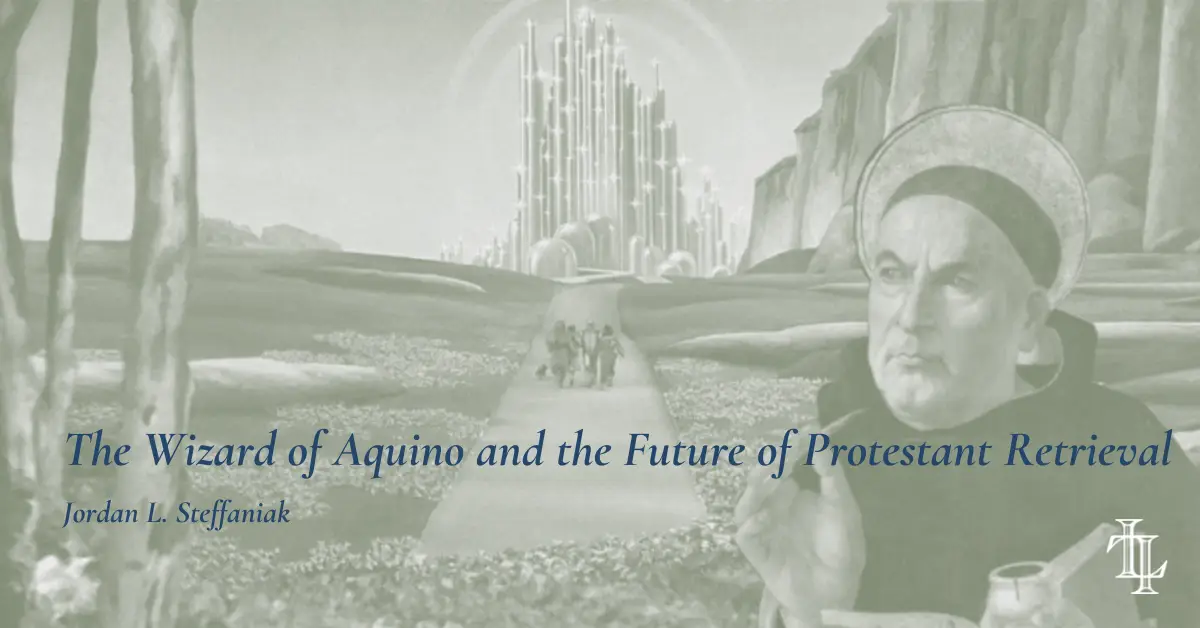
When we think of retrieval as the repetition of the past, we confuse its nature. Thinking this way projects an image to any paragon of the past, such as Thomas, that is only true in our heads. In turn, Thomas (and any other famed non-Protestant) becomes a terrifying wizard who mesmerizes anyone daring enough to read. But this dreadful reputation is entirely projection, like the terror of the Wizard of Oz, who turned out to be nothing more than a man despite what others feared. In the same sense, there’s no real magical power with Thomas. When you pull the curtain back and read him, he’s just another theological master whom we can learn from. And so, the anxiety around Thomas is misplaced.
Protestants shouldn’t be so shallow as to think that merely reading—even drinking deeply from—various historic Christian sources would invariably lead one to Rome. Thomas is not the wizard of Aquino. He’s a treasured resource whom more Protestants should read and contemplate. The same goes for any number of non-Protestant sources, regardless of age. Henry of Ghent, Cardinal Bellarmine, Joseph Ratzinger, Matthias Scheeben, Avery Dulles. You name it. All have treasures within. All should be read. Sure, there are some sources that are not worth your time. But no theological master will find their name on that list.
Still it’s worth unpacking this anxiety carefully. As with every specialized discipline in the arena of theology, there areunique temptations to wander, depending on our natural tendencies. Those dedicated to exegetical studies will oftentimes be taken captive by speculative Ancient Near Eastern constructions or Jewish documents, such as the midrash, more readily than a historical theologian. Those dedicated to philosophical study will oftentimes become seduced by novel and creative solutions to old problems more than a dogmatic theologian. And so on. So, while I dispute the need for fear, or even any real precaution, when reading sources like Thomas, it remains true that there are dangers in so-called theological retrieval.
However, the greatest dangers are no different than those of any theologian. All who seek to theologize are tempted by the pride of life to see oneself as a visionary or authority beyond others. All can be tempted by popular or trendy theological moves. All are tempted by sin to distort or fail to understand fully. Those intent on retrieval are not immune to these. Nor are those that fear retrieval. But there are unique inflections for those committed to studying at the feet of those who have passed, which ought to be explored.
3. The “Dangers” of Retrieval
Before unpacking the potential dangers of retrieval, we should be clear once more. The danger of retrieval does not lie in reading old sources. The danger is not in reading outside one’s own tradition. The “dangers” are more psychological. Broadly speaking, certain psychological impulses or drifts can arise from seeking to retrieve the past, especially when outside one’s own garden (though not exclusively).
2.1 The Temptation of Repristination
The most common danger of retrieval, in my view, is repristination. Those who attempt to inhabit the ethos of retrieval invariably lack the sensibilities of historical seclusion like those that section themselves off from the past because we are simply “Bible” people—or are much smarter than those that have gone before and have progressed beyond them. What they often do possess is a fondness for those who have gone before. It’s a good impulse. But if not carefully stewarded, this fondness can lead one to depart from retrieval to repristination. Repristination, by definition, is a repudiation of retrieval. While onlookers may point and jest at retrieval when they see those who repristinate, it’s not actually retrieval they are witnessing. The two may appear at a distance to be the same, but in practice they are very different.
Theologies of repristination are those of imitation. They seek to be like their past model. But theologies of retrieval seek not merely to emulate but to surpass the model. They want to surpass the past.2Jennifer A. Herdt, Putting on Virtue: The Legacy of the Splendid Vices (The University of Chicago Press, 2012), 116. The distinction is critical. Repristination is keen to merely repeat the past—the greatness of whoever may be under consideration. Whereas retrieval may repeat at points, they nevertheless intend to build upon the shoulders of those giants in creative yet faithful ways.
An example may help. It likely comes as no surprise, given my other writing, that I think Matthew Barrett is a prime current example of theological repristination, particularly of Thomas. He views Thomas through a lens that no Protestant ought. He’s viewed as the pinnacle of theological greatness, the measure of all sound theology, a pillar from which we should not depart. Thomas becomes “essential” for nearly every doctrinal loci: Trinitarianism, Christology, hermeneutics, natural theology, anthropology, providence, virtue, and more.3Matthew Barrett, The Reformation as Renewal: Retrieving the One, Holy, Catholic, and Apostolic Church (Zondervan, 2023), 14. The Protestant system is relegated to the “proper fulfillment” of Thomism.4Barrett, The Reformation as Renewal, 144. But this is fair to neither Thomism nor Protestantism. And that’s clear from Barrett’s own work, where in his defense of Protestant Thomism, he relies on “direct and indirect similarities and even references” to Thomas as his justification for his reverence for Thomas.5Barrett, The Reformation as Renewal, 174. To be clear, though, it’s not his attention to Thomas that’s concerning. Rather, it’s the need to fit square pegs into round holes to create a faux Thomistic consensus. We smooth over the rough edges of history that are for our good. Suddenly, Calvin becomes a “scholastic.”6Barrett, The Reformation as Renewal, 164; 176–77. Likewise, Thomas mysteriously agrees with Reformed dogma on the atonement.7Barrett, The Reformation as Renewal, 154. But this is not retrieval. It’s repristination. Retrieval is more given to creative appropriations of Thomas (or any past theologian) for the present. There is no need to force the dead into our own modern constructs. Said otherwise, we stand on their shoulders and not in their shadows.
A more prescient example is that of the Roman Catholic Ryan Hurd. In a recent Substack post, he detailed his conversion to Roman Catholicism. Throughout his essay, he is quite transparent as to his rationale for becoming Roman: “The name of that reason is Thomas Aquinas.” Thomas was never wanting. As Hurd explained at length:
As I became intellectually obliged to follow Thomas wherever he leads me, so withholding my assent became intellectually unjustified–even regarding those contradictions where, initially, I had no reasons for the Catholic part, or even my remaining Protestant doubts. Remarkably, I became obliged to conclude Catholicism, merely because Thomas had told me to do so. And in the end, I listened.8Ryan Hurd, “Why I’ve Become Roman Catholic,” Substack newsletter, Quodlibeta Theologica, April 7, 2026, https://rmhurd.substack.com/p/why-ive-become-roman-catholic.
I’m not here to judge personal convictions or intellectual journeys. But I do want to note that this is exactly the sort of repetition that is inherent to repristination rather than retrieval. Blind trust to follow the master wherever he leads is misplaced.
While many may set out to retrieve the past, they often fall into mere repetition. This could be due to any number of factors. Sometimes it arises from anxiety to meddle with the past. If it has been received for centuries, we shouldn’t touch it. If it isn’t broken, don’t fix it, as the saying goes. Sometimes it’s an anxiety of our own frailty. How are we to build upon the greatest theological master’s work? Other times, it is due to an amateur command of the sources. We lack the breadth of understanding that leads to a more seasoned and nuanced approach. But to be fair, repristination isn’t all bad—it’s fine and good where our repetition of the past is repetition of the truth. But only Holy Scripture is without error in full. And so endless repetition of sources beyond the Bible is bound to lead to error along the way.
A species of repristination is worth mentioning at this stage: lionizing the dead. When you go about apprenticing yourself to a theological master, it’s natural to develop a bond with the long since departed. As hours turn to days, turn to weeks, and months, curiosity or suspicion turns to trust and delight. But without proper academic and ecclesial socialization, one can follow the path of the lionizer. After all, the dead can’t rebuke us pointedly. And so, we become enmeshed with our patron saint of choice. Protestants surely have seen this amongst their own. Freshly minted Calvinists can see no wrong in Calvin’s thinking and treat others with disdain who fail to properly cherish him. They likewise often misunderstand Calvin’s very own thought because of their zeal.
The temptation of the lionizer is more than mere repristination. It’s a conscious devotion to one’s departed mentor that lacks boundaries. Reverence is a proper posture toward one’s heirs. But blindness toward fault and weakness is foolish. The lionizer doesn’t merely mimic their mentor. They fault those who don’t likewise follow in slavish devotion. They lack the proper balance of true honor, which does not bestow that which has not been earned or deserved. In our case, we should honor the many excellent theological masters of the past. But none deserve unwavering devotion.
2.2 The Temptation to Cheat the Process
There’s a further interesting temptation for those seeking to mine resources from the past in our current agent, which has only recently become widely possible. With the growth of the internet and the digitization of formerly inaccessible documents, we’ve often become intellectually lazy. Add in the AI tools that can make these numerous sources not only available for reading but also translate them in mass quantities and instantly provide summaries and searches for relevant material, and we’ve cheated ourselves of the essential process of retrieval. Retrieval is not merely about the end result. It is not merely about the use of the sources but also about the communion with the sources. There is an essential element that lives in the process of learning a language, learning a culture, and re-reading sources to understand the meaning that cannot be outsourced or fast-tracked. Expertise takes time. But when our communing with the sources is outsourced, retrieval dies and is replaced by an unrecognizable beast of burden. AI translation may provide a good deal of access to more sources, but when improperly used (which it so often is), we lose the decades of communing with the dead that form us and create the necessary habits to responsibly wield the sources for the present.
In the mad rush to access the past that previous generations lacked, we are tempted to cut corners. We lack a mastery of the language. We lack the ability to research properly and to compare past insights with what we argue for in the present. We become fools in our dash for unlimited knowledge.
2.3 The Temptation to Inverted Authority
Finally, the greatest danger in retrieval is inverting the hierarchy of authority. This is a combination of repristination and lionizing. So it’s not really a distinct danger so much as it is an inflection of them. Those who apprentice themselves to a past master (a very good and healthy thing to do) can unknowingly allow their views to become more authoritative than those of their local church, their own church confession, or even Scripture itself.
The antidote to this is nothing other than regular church attendance, worship, the sacraments, reciting the creeds, prayer, and reading of Scripture. There’s nothing new here. It’s the same old advice we’ve always had. But those of us who intend to spend decades with the writings of those in the past must always remember: it’s our living church body today that we must prioritize. The Lord has placed us in this time and space for a reason. And we cannot neglect the wisdom and authority of our own elders.
4. How Should We Then Live?
In the end, the Wizard of Aquino isn’t fearsome. He’s not set apart as a truly angelic doctor, despite his namesake. We shouldn’t worry about reading him turning us to Rome. In fact, he’s part of our heritage, and he deserves our respect. But there are dangers for those who lack the necessary virtue to produce theological material for the church. We need dependence on Scripture and the church to nourish, sustain, and guide us.