Editor’s Note: This Book Review is part of our Biblical Covenants and the Conflict in the Middle East series, in which we bring together scholars with differing views on the relationship between the Biblical covenants and examine how their views affect the current conflict in the Middle East.
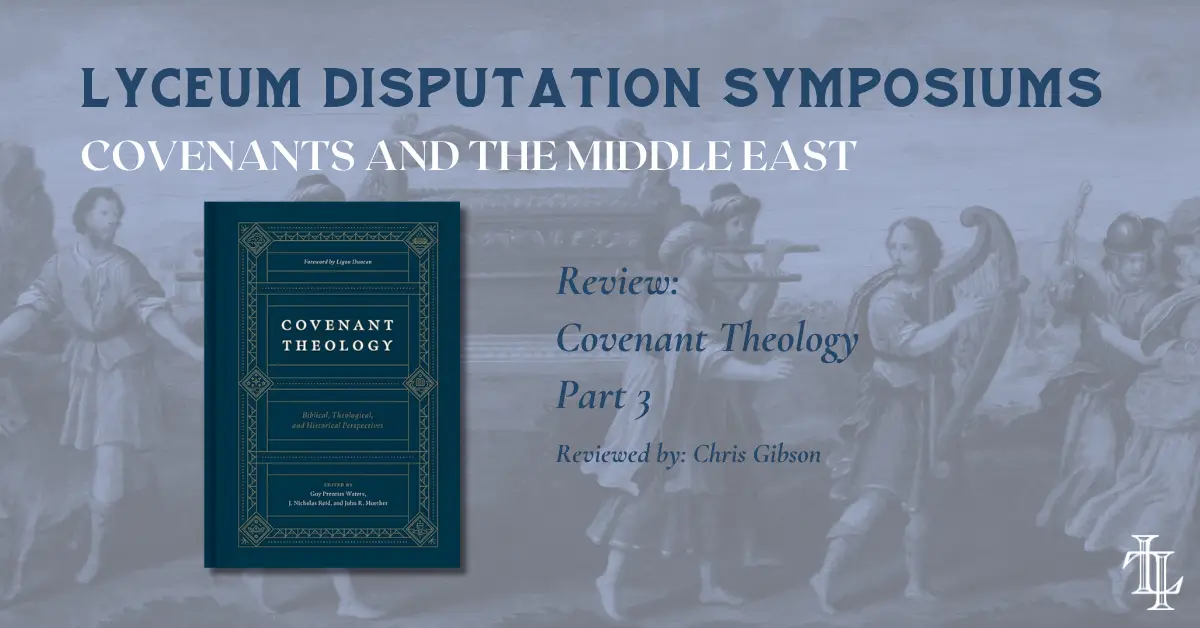
This review is the third installment in a three-part review. Part One examined the volume’s biblical-theological foundations; Part Two turns to the historical development of covenant theology across the life of the church. This final installment will address Part Three’s systematic and contemporary engagements.
Part Three of this impressive volume (447–672) shifts from the exegetical and historical foundations laid in Parts One and Two into a series of collateral and theological studies. Spanning seven chapters plus a pastoral Afterword and a substantial annotated bibliography, this concluding section broadens the conversation by situating the biblical covenants in their ancient cultural contexts, engaging alternative theological systems with charity and precision, and drawing out the practical implications of covenant theology for assurance, the sacraments, and the life of the church. Written by RTS faculty and distinguished contributors, these essays maintain the volume’s consistently confessional yet charitable tone, demonstrating that classic Reformed covenant theology is not only biblically and historically robust but also culturally informed, theologically discerning, and pastorally fruitful. The section reinforces the book’s central claim that covenant provides the architectural unity of Scripture and serves the church in every generation (447–448).
- Nicholas Reid opens with “Ancient Near Eastern Backgrounds to Covenants” (447–466). Drawing on his expertise in ancient Near Eastern studies, Reid carefully compares biblical covenants with Hittite suzerain-vassal treaties and Mesopotamian royal land-grant documents. He acknowledges genuine formal parallels—such as historical prologues, stipulations, blessings and curses, and ratification ceremonies—while insisting that God sovereignly employs these recognizable cultural forms without being bound by them. The biblical covenants, Reid argues, are theologically transcendent, rooted in Yahweh’s gracious initiative and hesed rather than political reciprocity or royal self-interest. This chapter effectively counters both uncritical parallel–seeking and overly dismissive readings that ignore the ancient context.
Peter Y. Lee’s “Covenant and Second Temple Judaism” (467–484) surveys a wide range of intertestamental literature, including the Apocrypha, Pseudepigrapha, and Dead Sea Scrolls. Lee highlights the diversity of covenantal thought in the period—ranging from nationalistic emphases in 1–2 Maccabees to the Qumran community’s self-understanding as the faithful remnant living under a renewed new covenant. He shows how the New Testament both draws upon and redefines these expectations in Christ, particularly in its teaching on forgiveness, the indwelling Spirit, and Gentile inclusion. The chapter provides essential background for interpreting Paul and Hebrews without reducing the gospel to a mere extension of Second Temple covenantalism.
Benjamin L. Gladd’s “Covenant in Contemporary New Testament Scholarship” (485–502) offers a lucid and even-handed survey of recent debates. Gladd engages the New Perspective on Paul, narrative approaches, and ongoing discussions of the law–gospel relationship, evaluating them fairly while demonstrating that the classic Reformed framework—centered on the one covenant of grace with varying administrations—best accounts for the canonical data. His treatment is especially helpful for readers navigating contemporary Pauline studies.
- Palmer Robertson’s “Israel and the Nations in God’s Covenants” (503–524) is among the most distinctive contributions. Robertson traces the Abrahamic promise that “in you all the nations of the earth shall be blessed” (Gen. 12:3) through the narrowing and broadening movements of redemptive history. He argues that after the exile the surviving people are more accurately “Judeans,” and the new covenant fulfills the promise by incorporating believing Jews and Gentiles into one multi–ethnic people of God. The chapter provides a balanced covenantal alternative to both dispensational futurism and certain forms of supersessionism.
Michael J. Glodo’s “Dispensationalism” (525–550) and Scott R. Swain’s “New Covenant Theologies” (551–570) form a strong pair of constructive engagements. Glodo traces dispensationalism from John Nelson Darby through the Scofield Reference Bible to progressive dispensationalism, acknowledging its strengths in biblical literalism and zeal for God’s faithfulness while critiquing its sharp Israel/church dichotomy and compartmentalized view of redemptive history. Swain offers a similarly charitable yet incisive analysis of New Covenant Theology, commending its grace-centered instincts while arguing that its rejection of the covenant of works and the one covenant of grace undercuts the unity of Scripture and the theological foundation for Christ’s active obedience. Both chapters model the kind of discerning, non-polemical engagement that characterizes the volume.
Derek W. H. Thomas’s “Covenant, Assurance, and the Sacraments” (571–588) shifts to pastoral theology with characteristic warmth and clarity. Thomas shows how covenant categories ground solid assurance in God’s faithfulness rather than fluctuating human performance and enrich the Reformed understanding of baptism and the Lord’s Supper as visible signs and seals of the covenant of grace. The chapter ties the entire project together by demonstrating the practical, ecclesial fruitfulness of covenant theology.
Kevin DeYoung’s Afterword, “Why Covenant Theology?” (589–598), adapted from a sermon, serves as an inspiring pastoral capstone. DeYoung distills the volume’s message into an accessible, gospel–saturated appeal—covenant theology is the Bible’s own storyline, revealing God’s desire for communion with his people, centering Christ as the substance of every covenant, and furnishing believers with unshakable assurance and joyful obedience. His concluding emphasis on the covenant formula—“I will be your God and you will be my people”—leaves readers motivated to embrace covenant theology not as abstract doctrine but as living truth.
John R. Muether’s “An Annotated Bibliography of Reformed Reflection on the Covenant” (599–624) provides a fitting scholarly close. Organized thematically and annotated with concise, discerning comments, it guides readers to primary sources from Calvin, Bullinger, Cocceius, Witsius, Owen, Turretin, à Brakel, and modern voices. The bibliography is selective yet comprehensive, serving as an ideal launching point for further study.
Several prominent themes unify Part Three. First, contextual illumination without reductionism—the covenants are culturally intelligible yet theologically unique (chs. 21–22). Second, charitable yet discerning engagement with alternative systems—both dispensationalism and New Covenant Theology receive fair hearing before measured critique (chs. 25–26). Third, pastoral and ecclesial fruitfulness—covenant theology anchors assurance, shapes sacramental practice, and fosters a unified, multi–ethnic people of God (chs. 24, 27). Fourth, Christocentric unity—every chapter returns to Jesus as the mediator and substance of the covenants, fulfilling the promises made to Israel and the nations.
The contributors have succeeded admirably. The writing is accessible without sacrificing depth, and the section’s placement after the biblical and historical parts allows readers to see covenant theology as both ancient and immediately relevant. Minor limitations—such as the inevitable brevity of surveys—are more than offset by the cumulative force and pastoral orientation of the whole.
Taken together, Part Three, the Afterword, and the Annotated Bibliography complete a truly thorough and well-rounded volume of study. The book as a whole stands as an outstanding contribution to Reformed scholarship—exegetically responsible, historically informed, theologically coherent, and pastorally warm. It deserves a prominent place in seminary classrooms, where it will equip the next generation of pastors to preach the unity of Scripture with clarity and conviction. It will also serve as a reliable resource for pastors and thoughtful lay leaders in a wide range of ministry contexts, offering both intellectual depth and practical wisdom. Highly recommended.