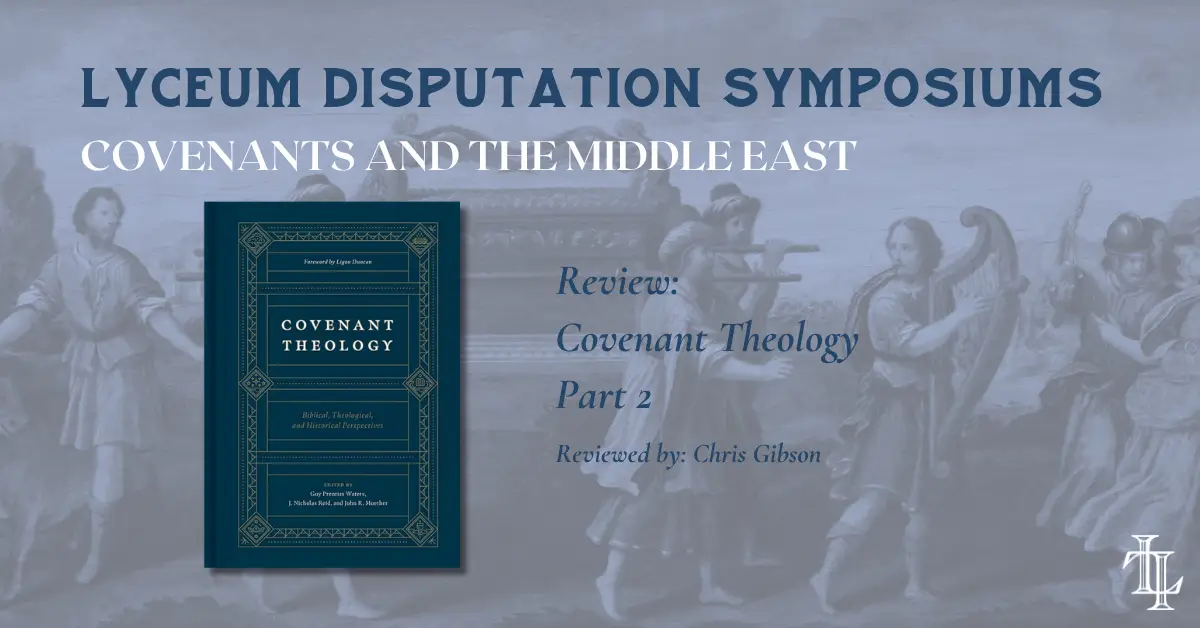
Editor’s Note: This Book Review is part of our Biblical Covenants and the Conflict in the Middle East series, in which we bring together scholars with differing views on the relationship between the Biblical covenants and examine how their views affect the current conflict in the Middle East.
This review is the second installment in a three-part review. Part One examined the volume’s biblical-theological foundations; Part Two turns to the historical development of covenant theology across the life of the church. A final installment will address Part Three’s systematic and contemporary engagements.
In Part One of this volume, the contributors demonstrated through sustained canonical exegesis that classic Reformed covenant theology is not an artificial scholastic grid imposed upon Scripture but rather arises organically from the Bible’s own storyline—from the eternal counsel of the Trinity to the consummation of the new creation in Christ. Part Two, including chapters 14–20 (367–552)—takes up the natural and necessary next question: How has the church historically received, articulated, and refined these covenantal insights? Far from shifting attention away from Scripture, this section argues that historical theology, when practiced responsibly, serves biblical theology by tracing the church’s long effort to confess faithfully what Scripture teaches.
The seven essays that comprise Part Two provide a sweeping survey of covenant theology across two millennia of Christian history. Written by members of the Reformed Theological Seminary faculty and framed self‑consciously within the confessional boundaries of the Westminster Standards and the Three Forms of Unity, these chapters seek neither to baptize every pre‑Reformation theologian as a proto‑federalist nor to dismiss earlier periods as theologically barren. Instead, they advance a historically sensitive and theologically disciplined thesis: classic Reformed federal theology represents the mature articulation of biblical patterns and instincts present—often implicitly—from the church’s earliest centuries onward (380, 415, 435).
- Ligon Duncan III opens Part Two with “Covenant in the Early Church” (367–392), establishing both the historical scope and the methodological restraint that characterize the entire section. Duncan candidly acknowledges that the patristic writers did not articulate covenant theology in the later technical sense, nor did they distinguish formally between a covenant of works and a covenant of grace. Yet absence of later terminology does not entail absence of covenantal reasoning. Duncan demonstrates that the early fathers regularly employed covenantal categories to defend the unity of Scripture, the continuity of God’s saving purposes, and Christ’s fulfillment of Old Testament promises.
Irenaeus’s doctrine of recapitulation is especially significant. By presenting Christ as the one who retraces and redeems the history of humanity in Adam, Irenaeus presupposes a representative, covenantal understanding of redemptive history (378–380). Augustine’s mature theology, particularly in his anti‑Pelagian writings, further sharpens distinctions between law and grace, nature and grace, and human inability and divine initiative—distinctions that would later be given formal covenantal expression (381–385). Duncan’s treatment is careful and measured, avoiding anachronism while showing that patristic theology supplied indispensable conceptual building blocks for later federal theology.
Douglas F. Kelly’s chapter on medieval theology (393–418) continues this pattern of nuanced historical judgment. Kelly readily concedes that covenant never functioned as the organizing category of medieval scholastic theology. Nonetheless, he demonstrates that covenantal instincts persist beneath the dominant sacramental and merit-based frameworks. The superiority of the new covenant, the unity of God’s redemptive plan, and the role of the sacraments as divinely instituted signs of grace appear repeatedly in figures such as Anselm, Peter Lombard, and Thomas Aquinas (400–410).
Kelly carefully balances continuity and critique. Medieval theology preserved important insights that the Reformers would later appropriate, even as it developed problematic notions of merit and infused grace that obscured forensic categories central to justification. Rather than portraying the Reformation as a sharp rupture, Kelly presents it as a moment of clarification and retrieval, refining “raw materials” already present in the tradition (410–415).
Howard Griffith’s contribution (419–445) marks a decisive turning point. In the sixteenth century, covenant emerges not merely as an implicit logic but as an explicit theological category employed in exegetical, pastoral, and polemical contexts. Griffith traces how Zwingli and Bullinger appealed to covenant continuity to defend infant baptism and the unity of God’s people against Anabaptist claims of radical discontinuity (422–430).
John Calvin receives sustained attention—not as the inventor of covenant theology, but as its foremost Reformation integrator. Griffith shows how Calvin weaves covenant into both historia salutis and ordo salutis, grounding salvation in Christ’s mediatorial work while presenting the sacraments as confirming signs of divine promise (430–440). In doing so, Griffith explicitly resists the “Calvin versus the Calvinists” caricature, arguing instead that later federal theology codified and systematized impulses already present in Calvin’s exegetical and pastoral theology.
- Blair Smith’s essay on post‑Reformation developments (447–472) addresses the seventeenth‑century maturation of covenant theology. This period, often dismissed as rigid scholasticism, is presented here as one of faithful doctrinal refinement under significant polemical pressure. The Westminster Confession’s articulation of the covenant of works and covenant of grace (Confession 7) emerges as a careful attempt to safeguard biblical teaching on Adamic probation, Christ’s representative obedience, and justification by faith alone (pp. 450–460).
Smith’s treatment of theologians such as John Owen, Thomas Goodwin, Samuel Rutherford, and Francis Turretin underscores the exegetical rigor and pastoral concern that characterized high Reformed orthodoxy. Federal theology functioned as a means of defending assurance, clarifying the law‑gospel distinction, and responding to challenges from Arminianism, Socinianism, and Roman Catholic theology (460–468).
Bruce P. Baugus’s chapter (473–498) broadens the survey by turning to the Dutch Reformed tradition. From Junius and Gomarus through Cocceius, Voetius, Witsius, and à Brakel, Baugus demonstrates how Dutch covenant theology often emphasized the historical unfolding of redemption and the experiential dimensions of covenant life. Later figures such as Kuyper, Bavinck, and Vos further integrated covenant theology with ecclesiology, worldview analysis, and biblical theology (485–495).
Although the Three Forms of Unity do not articulate federal distinctions with the precision of Westminster, Baugus convincingly argues that they presuppose a robust covenantal framework. The Dutch tradition thus complements, rather than competes with, British Puritanism.
The final two chapters engage modern developments with critical charity. Mark I. McDowell’s analysis of Karl Barth and the Torrances (499–520) carefully acknowledges the appeal of their Christocentric and Trinitarian emphases, particularly the claim that “Jesus Christ is the covenant.” Yet McDowell demonstrates that their rejection of the covenant of works, federal headship, and forensic justification constitutes a significant departure from historic Reformed orthodoxy (510–518). The result, he argues, is a flattening of redemptive history and a weakening of the law‑gospel distinction, with corresponding pastoral implications.
Michael Allen concludes Part Two with “Covenant in Recent Theology” (521–552). By juxtaposing Michael Horton’s retrieval of classical federal theology with John Webster’s more relational and revisionary proposals, Allen models the discerning engagement the volume consistently commends. He calls for a retrieval that incorporates contemporary Trinitarian and biblical‑theological insights without relinquishing the confessional gains of the seventeenth century (540–550).
Across these chapters, several unifying themes stand out. First, the organic development of covenant theology emerges gradually as the church responds to Scripture and controversy, always returning to the biblical text. Second, there is a confessional fidelity paired with historical sensitivity that earlier theologians neither anachronistically conscript nor casually dismiss. Third, there is a charitable yet principled engagement—modern revisions are assessed sympathetically but critically. Fourth, the pastoral and Trinitarian depth of covenant theology consistently serves assurance, worship, preaching, and the life of the church.
As a continuation of Part One, this section provides essential historical ballast for the claim that covenant theology is Scripture’s own architecture. By tracing how the church has confessed these truths across the centuries, Part Two prepares the way for Part Three’s systematic and contemporary reflections. Together, these essays remind readers that covenant theology is not a relic of the past but a living framework for proclaiming the covenant‑keeping God who has fulfilled every promise in Jesus Christ.