
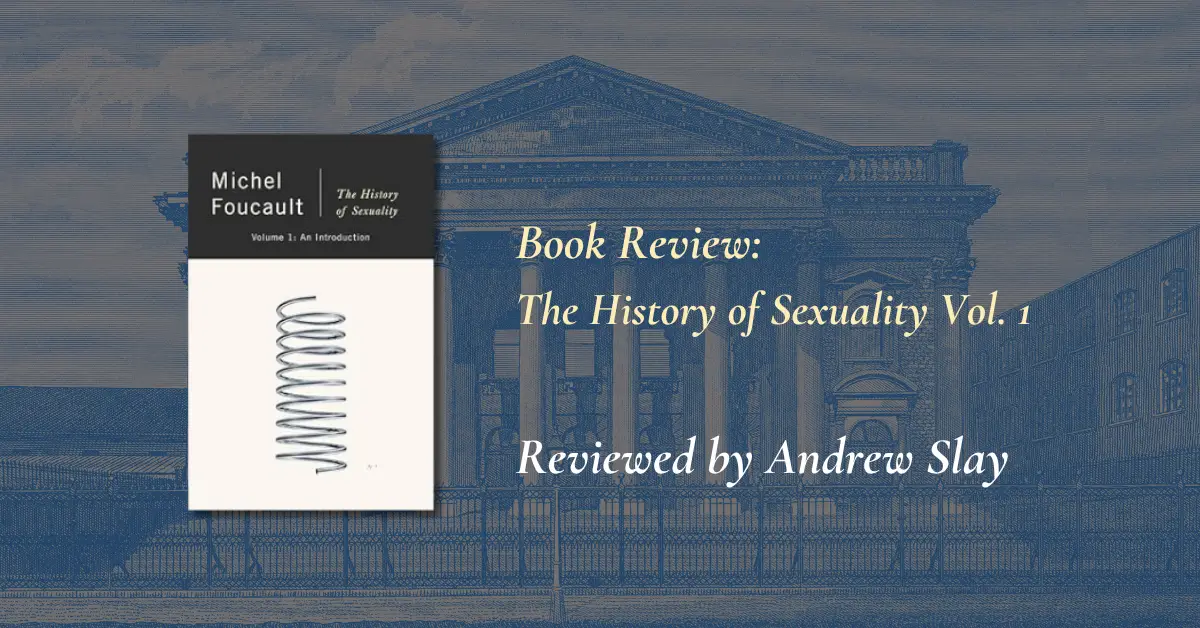
In The History of Sexuality, Volume 1, Michel Foucault argues that sexuality is not a given, but rather it is constructed through discourse. Despite many who claim sexuality has been repressed since its creation, especially in the Victorian age, this repression is actually a mirage. Ironically, the repression and prohibitions propagated by priests in the early church, to the Victorian age in the seventeenth century, further added propane to the fire of sexuality by increasing discourse about our deepest desires. Foucault’s aim is not to write a chronological history of sexuality. Instead, his goal is to trace the genealogy of how and why the concept of sexuality was created and used for the will to knowledge and power in different groups of society. In short, Foucault’s book explains the why and how, not the what of sexuality. To understand Foucault’s analysis of history, a definition of genealogy from Gary Gutting will be helpful here: “A Foucaultian genealogy, then, is a historical causal explanation that is material, multiple, and corporeal. . . His genealogies, therefore, should present particular reasons why we should doubt the claims to cognitive authority made by specific disciplines, not reasons to doubt any such claim at all.”[1]
Foucault begins his history focusing on the myth of repression from the Victorian age in the seventeenth century. He argues that the “Victorian repression” transformed sex into discourse. Sex was transformed into discourse through censoring it, while at the same time, the Pastoral calling people to speak about sex in extreme detail during confession (pp. 19-20). The creation of sex as discourse also transformed every desire into discourse. For Foucault, what we confess is what we desire, and what we desire is who we are.[2] Through discourse, sex became like a medicine that was administered to its patients instead of an abstract object to be judged in a courtroom. For Foucault, sex was not policed by repression, but rather it was regulated through practical and public discourse (p. 24). One example is seen in controlling the discourse of sex through population studies (birth and death rates). Sex was widely discussed and studied to determine population trends and strategies for population growth, which would enable the economy to flourish (pp. 26-27). By creating sex as “taboo” in society, all people “dedicated themselves to speaking of it ad infinitum, while exploiting it as the secret” (p. 35).
This creation and controlling of sex through discourse led to the “perverse implantation” of labeling anything that deviated from the norm as an “abomination” in society (p. 36). Through seeking to regulate sexuality through the discourse of repression, the people in the 19th century ironically did not lessen sexual expression but instead multiplied various dispersions of sexualities and initiated diverse sexualities (p. 37). Sexual actions and desires that deviated from the norm (law of marriage and sexual desires according to nature) were “contrary to nature” and labeled as “transgressions” because they broke the canonical, civil, and pastoral law codes that governed society and allowed it to flourish (p. 38). This persecution and denunciation of diverse sexualities led to the creation of a new specification of individuals (p. 43). For example, in the nineteenth century, Sodomy was transformed from an act to a person who had a specific anatomy and possibly a mysterious physiology. Homosexual acts morphed from a habitual sin to one’s very own nature and how they viewed the world (p. 43). In short, through seeking to create a rigid barrier against sexuality, society has caused a massive birth in perverse sexual acts and made the sexual instinct a disease (p. 47). Foucault says, “The growth of perversions is not a moralizing theme that obsessed the scrupulous minds of the Victorians. It is the real product of the encroachment of a type of power on bodies and their pleasures” (p. 48).
Once the “perverse implantation” through discourse was created, society became fixed on the hypothesis that anyone who deviates from the sexual norm must have physiological or psychological issues. This led to increased medical examinations for those who deviated from the established norm (p. 44). As a result, Foucault argues that science grounded sexual deviations as “truth” and “fact” because they were based on their research and examinations (p. 54). Foucault says, “Science made sex a problem of truth, even when they denied the evidence. Misunderstandings and evasions of sex were only possible when scientists took up the endeavor to tell the truth of sex” (p. 56). Sex can be told as “truth” in two ways: (1) ars erotica, and (2) scienta sexualis. In erotic art (ars erotica), truth is drawn from pleasure itself. Truth is “what feels good.” But for Foucault, he believed society has embraced sicenta sexualis as the primary form of “telling the truth” about sex
Scienta sexualis is telling the truth of sex through a form of knowledge-power speech acts. Truth does not come through art, but rather from confession. Foucault says that in the West, since the Middle Ages, confession has become one of the most valued techniques for producing truth. In confession, truth and sex are joined through the expression of an individual secret (p. 61). On this point, Watkin surmises that through confession, we become who we are. Confession is the shaping of the self.[3] These forms of truth-telling through confession are not only found in the church’s confessional, but also in clinics. When doctors analyze their patients’ symptoms of deviant sexual desire and practice, they ask them to confess all of their thoughts, inclinations, and desires to “tell the truth” about how and why their sexuality is objectively disordered. Ironically, the scienta sexualis has created a new form of pleasure of the truth of pleasure and knowledge, and is essentially a subtle form of ars erotica (p. 71). Through this creation of truth about sex through the scienta sexualis of confession, sex could be understood as objectively true and hence be wielded for knowledge and power in society.
In the final sections of Foucault’s history of sexuality, he lays out how sexuality was “deployed” and used as a structure of power in society in four ways. First, the objective of this deployment was for the West to keep power over sex through negative dialogue, cycling prohibitions, the logic of censorship, and the uniformity of the apparatus (p. 83-85). Second, the method of deployment was to analyze forms of knowledge of sex, not by repression, but by power. Foucault proposes four “cautionary prescriptions” to discover these power relations: (1) rule of immanence, (2) rules of continual variations, (3) rule of double conditioning, and (4) rule of multiple forms of discourse (discourse is not binary).
Third, there are specific domains where sexuality is deployed, and sexuality should be viewed as a dense transfer point of power relations (p. 103). From the eighteenth century on, there have been four great strategic unities that formed specific mechanisms of knowledge and power that centered on sex: (1) hysterization of women (a woman’s entire body is saturated with sexuality), (2) a pedagogization of children’s sex (masturbating child), (3) a socialization of procreative behavior (Malthusian couple), and (4) a psychiatrization of perverse pleasure (sexual instinct was isolated as a separate biological and physical instinct). Each of these four strategic unities has one thing in common: they are all tied to the family. Thus, for Foucault, the concept of the family represented the most significant deployment of sexuality for knowledge and power (p. 111). Fourth, there was a periodization of the deployment process of sexuality with two great ruptures in its history. First came the “great prohibitions” of sexuality in the seventeenth century. Second, there was the loosening of the mechanisms of repression in the twentieth century.
In between these two ruptures was the shift of sexuality from the sacred to the secular. During the eighteenth century, sex shifted away from being strictly the focus of the Church to being the focus of society through pedagogy (sexuality of children), medicine (physiology of women), and demography (regulation of births) (p. 116). In short, the flesh (religious) was brought down to the level of the organism (secular) (p. 117). The mechanisms of sexualization that were deployed in the eighteenth and nineteenth centuries were an identification with birth control, the organization of the “conventional family” that led to the subjugation of the urban working class, and the development of the medical control of perversions for the sake of the general protection of society
Through the shift of sexuality from the sacred to the secular, the focus of society was to use sexuality to affirm one’s self and preserve the health of one’s body so that a superior class’ progeniture could be protected and propagated. Foucault posits, “The primary concern was not repression of the sex of the classes to be exploited, but rather the body, vigor, longevity, progeniture, and descent of the classes that ruled. This was the purpose for which the deployment of sexuality was first established. . . it has to be seen as the self-affirmation of one class rather than the enslavement of another. . . What was formed was a political ordering of life, not through an enslavement of others, but through an affirmation of self” (p. 123). Thus, the Victorian bourgeoisie did not repress sex to keep people from having sex and working, but did so to form a specific class body of health, hygiene, descent, and race to affirm their class and allow it to flourish (p. 124). The Bourgeoisie’s blood became their sex. These “sexual repressions” kept them from having sex with those of a “lesser class” and encouraged them to only marry within the “Bourgeoisie family.” As a result, this created a “Bourgeois” sexuality and “proletariat” sexualities. As a response, the sexual revolution and the anti-repressive struggle were a tactical shift and reversal in the significant deployment of sexuality
In conclusion, Foucault says that “sex” was an idea created in the inner structures of the deployment of sexuality. The creation of sex through the deployment of sexuality created three functions. First, the notion of “sex” allowed us to group individuals together based on anatomy and pleasures so that sex was able “to function as a unique signifier and as a universal signified” (p. 154). Second, by creating a unitary fashion through anatomy and pleasures, sex was able to connect the knowledge of human sexuality with the biological sciences of reproduction. This allowed the understanding that human sexuality could either be labeled “normal” or “disordered.” Third, “the idea of sex makes it possible to evade what gives ‘power’ its power; it enables one to conceive power solely as law and taboo” (p. 155). In short, power deploys sexuality for means of control, and its key tool for success is sex, which “grips our bodies, their materiality, their forces, energies, sensations, and pleasures” (p. 155). We don’t realize that power is gripping us and controlling us because our entire being is entrenched in sex. In fact, it is only through passing this “imaginary point” of sex that we can have access to our own intelligibility and identity (p. 155-156). What was once regarded as “the flesh” has come to make up our entire essence and identity. Through the deployment of sexuality, sex has now become sovereign, and we willingly sacrifice our lives on the altar of sex (p. 156). This insatiable desire for sex, ironically, is what continues to strengthen the deployment of sexuality and the very chains we seek freedom from. Foucault says, “it is this desirability that makes us think we are affirming the rights of our sex against all power, when in fact we are fastened to the deployment of sexuality that has lifted up from deep within us a sort of mirage in which we think we see ourselves reflected-the dark shimmer of sex” (p. 157).
Foucault’s thinking is clouded in much of what he writes in The History of Sexuality Volume 1, but this last statement rings some truth. In seeking liberty from the “repression of sexuality” by finding our identity in our sexual desires, we employ and strengthen the very chains we seek deliverance from.
[1] Gary Gutting, Foucault: A Very Short Introduction, (Oxford, UK: Oxford University Press), 2005, 47, 52.
[2] Christopher Watkin, Michel Foucault: Great Thinkers Series, (Phillipsburg, NJ: P&R Publishing), 2018, 56.
[3] Watkin, Michel Foucault, 56.