Editor’s Note: The London Lyceum publishes a range of book reviews by experts and pastors within Protestant confessionalism. As such, some reviews do not reflect the viewpoints of our directors.
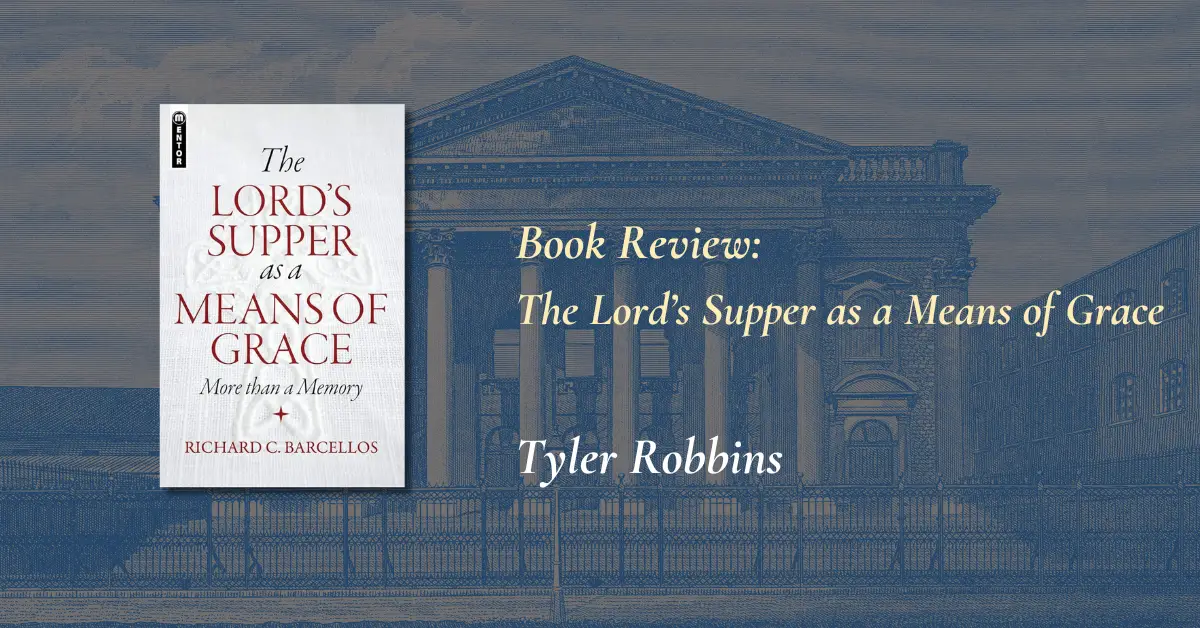
Barcellos is pastor of Grace Reformed Baptist Church, Palmdale, CA, and Associate Professor of Exegetical Theology at International Reformed Baptist Seminary. He contends that the Lord’s Supper is a means of grace which, along with the Word of God and prayer, are the “delivery systems” which bring grace to needy souls. Thus, it is a “soul-changing, soul-altering, spiritually nurturing ordinance” (18). It both reminds us of and enhances our covenantal bond (29). His aim in the book is not to prove this, but to explain how it works (22). “The material that follows is a pastor’s attempt at showing how the Supper is a means of grace” (12).
In ch. 1, he surveys some terminology common to the Lord’s Supper debates.
We get down to brass tacks in ch. 2 with 1 Corinthians 10:16. Barcellos spends a great deal of time discussing Greek syntax “for the purpose of showing my work …” (15). He says 1 Corinthians 10:16 is “the most important text in Paul which speaks about the nature of the Lord’s Supper” (35). In the larger context, Paul “is combating the sin of idolatry committed by some of the Corinthians by their ‘participating in pagan religious meals’” (38).
Following Anthony Thistleton, he argues that the focus is not social, but vertical (38). Barcellos concludes that “koinonia [“sharing,” NASB 2020] in 1 Corinthians 10:16 expresses a vertical, top-down reality, a reality connected to ‘the blood’ and ‘the body of Christ’. Paul’s emphasis is not that believers are together when they partake of the Lord’s Supper (though that is true), it is that koinonia constitutes some sort of relationship with ‘the blood’ and ‘the body of Christ’” (40). His gloss for koinonia is “present communion,” because Christ is alive right now—or else there would be nobody with whom to commune (41-42).
The genitives which follow the noun “koinonia” are genitives of source: “The source of communion with Christ would be his blood and his body.” Barcellos suggests: “If so, we could read it this way, ‘present communion derived from or dependent upon the blood and the body of Christ as its source” (40; emphases added). Boldly, he proclaims: “If I had an earned reputation as a Greek scholar, I would be tempted to identify these phrases as eucharistic genitives of the real presence of the present benefits of Christ’s death” (42).
Paul advances his argument in 1 Corinthians 10:18, Barcellos states, by making an analogous comparison between the Lord’s Supper (to participate in the cup = to have present communion with Jesus) to Jewish ritual sacrifices: to eat sacrifices = to participate in the cultic act. “[S]ome sort of identity is established between those who offer sacrifices and the altar” (42). The case is the same, he argues (43-44), with the partnership with demons that Gentiles trigger when they participate in their own pagan rituals (1 Cor 10:19-20).
Therefore:
The point being made from this text is that bread and wine are signs which signify present participation or present communion in the present benefits procured by Christ’s body and blood … Koinonia of the blood and body of Christ means spiritual nourishment is brought to souls (44).
This means a horizontal or memorial view of the Supper “does not fit the context or prove the point of Paul’s argument” (44). “Since believers already have communion with Christ via faith (1 Cor. 1:9), the Lord’s Supper must be viewed as a means to nurture what is already possessed … the Supper is a sanctifying ordinance.” (45).
In ch. 3, Barcellos argues that “Ephesians teaches that the Holy Spirit brings heavenly blessings to the souls of believers (1:3),” and so “[t]he benefits of Christ’s blood and body (1 Cor. 10:16) are spiritual blessings (Eph. 1:3), brought to souls by the Spirit of Christ” (40). He spends the bulk of the chapter discussing the syntax of Ephesians 1:3 and only dedicates one paragraph at the end to explain how this relates to the Lord’s Supper as an alleged means of grace.
Barcellos spends ch. 4 discussing prayer in Ephesians 3:14-21. “[T]o better understand the Supper as a means of grace, understanding prayer as a means and the ministry of the Spirit through prayer in relation to the blessings that are ours in Christ can fill in a theological gap which may still be lingering in the minds of some readers” (65). Once more, he steps out on an exegetical pilgrimage and only draws the purported threads together at the tail end of the chapter: “[P]rayer is a means through which the Father sends grace procured by the Son to the souls of men delivered by the Spirit.” So, when “[a]t the Supper, the minister prays” (74), the Spirit in turn sends grace through the Supper.
In ch. 5, Barcellos surveys several Reformed confessions and catechisms to show his conclusions are not out in left field. “If the exegetical and theological arguments from those chapters are cogent and reflect the mind of God as penned by Paul, then the Reformed creedal statements are accurate summaries of the Bible’s teaching” (92).
Finally, in ch. 6, he offers some “final thoughts.”
- The Supper is a trinitarian means of grace.
- We must understand the Spirit’s role in the Supper.
- The Word is the chief means of grace, and “Paul is the chief theologian of the Supper in the New Testament” (97).
- If his arguments are correct, then the Supper is more than a memory.
- We ought to emphasize joy and hope, not self-examination.
- We should observe the Supper more often.
- We ought to emphasize the Supper’s linkage to the past, present, and future in redemption.
Barcellos is rightly concerned with the flippant and casual attitude too many churches exhibit towards the Lord’s Supper. Too many people do not know what it is, what it does, or who ought to participate. His “final thoughts” (ch. 6) are very helpful.
His argument centers on 1 Corinthians 10:16, and he provides a defensible and competent justification for that argument by close examination of certain key phrases in the Greek original. Barcellos says anybody with two years of language study ought to be able to follow along (13). His arguments depend entirely on his exegetical work, so interested laymen likely cannot evaluate his arguments. However, it is extraordinarily refreshing to see a working pastor “show his work” in this manner. If God has spoken in the scriptures, then he has used words, and so any discussion about meaning must focus on what God is saying in those words. And so, if Paul truly is “the chief theologian of the Supper in the New Testament” (27), then we cannot declare what the Supper does for God’s people unless we look very carefully the words Paul wrote.
If a pastor is looking for a robust theology of the Lord’s Supper rooted deep in the Reformed tradition, complemented by an energetic exegetical foundation—all in 125 pages, then this is that book. However, for those who do not hail from Barcellos’ tradition, his book is less persuasive that it might have been.
The invisible foe. He does not cite a responsible author who takes the memorialist position—not even Zwingli. He does not explain what that position is or why people hold it. Yet, especially in ch. 5, he repeatedly declares: “The Lord’s Supper is more than a memory” (82ff). This leaves the other side curiously invisible. Millard Erickson notes that one perspective believes the Supper’s “potential for spiritual benefit is much the same as that of a sermon.”[1] How is this different than Barcellos’ means of grace in the Supper? If we knew who he was arguing against, perhaps we could answer that question.
Tip of the iceberg. Barcellos declares his goal is not to prove the Supper is a means of grace, but to show how that is so. Unfortunately, the title suggests otherwise. An unwitting reader may think this is a thorough defense of the position, but it is not—everything hinges on accepting his exegesis of 1 Corinthians 10:16. The result is a work that is too technical for normal readers, yet too limited in scope to persuade educated audiences from rival traditions. In short, this book preaches to the choir.
Effectual for salvation? Barcellos cites the Westminster Shorter Catechism’s statement that the Supper is “effectual to the elect for salvation” (90). This is extraordinarily troubling language to the uninitiated, and he does not hasten to temper these words. He then cites more language, to wit:
“The sacraments become effectual means of salvation … only by the blessing of Christ, and the working of his Spirit in them that by faith receive them,” and “[t]he Lord’s Supper is a sacrament, wherein … the worthy receivers are … by faith, made partakers of his body and blood, with all his benefits, to their spiritual nourishment, and growth in grace” (91, emphases added).
Because Barcellos does not explain this alarming language (maybe the choir is already in the know?), some readers will likely misunderstand him to mean the Supper both saves people and brings them into effectual union with Christ. If true, this would be blasphemy. This needed clarification. If there is a spectrum to the “means of grace” perspective, Barcellos would have done well to lay out where he stands on the taxonomy vis-à-vis the shorter catechism.
Greek to me? The detailed Greek exegesis of Ephesians 1:3, 3:14-22 (chs. 3-4) was probably unnecessary—the subjects are not controversial. In large part, Barcellos’ case for the Supper as a means of grace depends on the classification of two genitives in one verse from the entire bible. Because Barcellos believes 1 Corinthians 10:16 is “the most important text on the nature of the Lord’s Supper as means of grace in the New Testament” (35), it is well and good to lean into this verse. But, as a wise man once said, “You come at the king, you best not miss.”
Unfortunately, Barcellos does not discuss the entire verse. Instead, he concentrates on koinonia + two genitives. But what is a “cup of blessing?” In what way do believers “bless” it? How does this relate to the “fellowship/sharing?” He does not say. Barcellos relies heavily on commentaries and dictionaries to make his arguments for him. Is this really a vertical “sharing?” Are the genitives really genitives of source? Are there other good options? He does not say.
Indeed, his argument for the Supper as a means of grace chiefly hinges on seeing the genitives as denoting source (“from the body/blood of Christ”), but multiple grammars say this construction is unlikely.[2] While he acknowledges that genitives are tricky (42, fn. 19), Barcellos does not evaluate the options and provides no reason why he rejects other syntax categories unfriendly towards his position.
Can the genitives here truly carry the freight Barcellos is piling on? This is sometimes the sign of a brittle argument. Dispensationalists do something similar with their insistence that a preposition in Revelation 3:10 (τηρήσω ἐκ τῆς ὥρας) demonstrates the pre-tribulational rapture. Barcellos’ exegetical conclusions are competent and defensible, but he would have been more persuasive if he interacted with the opposing view.
All told, Barcellos provides a helpful explanation for a friendly audience about how those in the Reformed tradition believe the Supper is a means of grace.
[1] Millard Erickson, Christian Theology, 3rd ed. (Grand Rapids: Baker, 2013), 1039.
[2] By the New Testament period the source and derivation concepts were quite often expressed by ἐκ + genitive. So, if we do not have this construction (as we do not at 1 Cor 10:16), then we ought to not choose the “source” category if something else fits (Daniel Wallace, Greek Grammar Beyond the Basics (Grand Rapids: Zondervan, 1996), 109).
This caution (source = ἐκ (or ἀπό) + genitive) is echoed by numerous other Greek grammars under a discussion of the ablative: A. T. Robertson (A Grammar of the Greek New Testament in the Light of Historical Research (reprint; Bellingham: Logos, 2006), 519), H. E. Dana and Julius R. Mantey (A Manual Grammar of the Greek New Testament (Toronto: MacMillan, 1957), 79-80), F. Blass, A. Debrunner, and Robert Funk (A Greek Grammar of the New Testament (Chicago: University of Chicago, 1961) ¶180), and James Moulton, A Grammar of the Greek New Testament, Volume III—Syntax (Edinburgh: T&T Clark, 1963), 235).