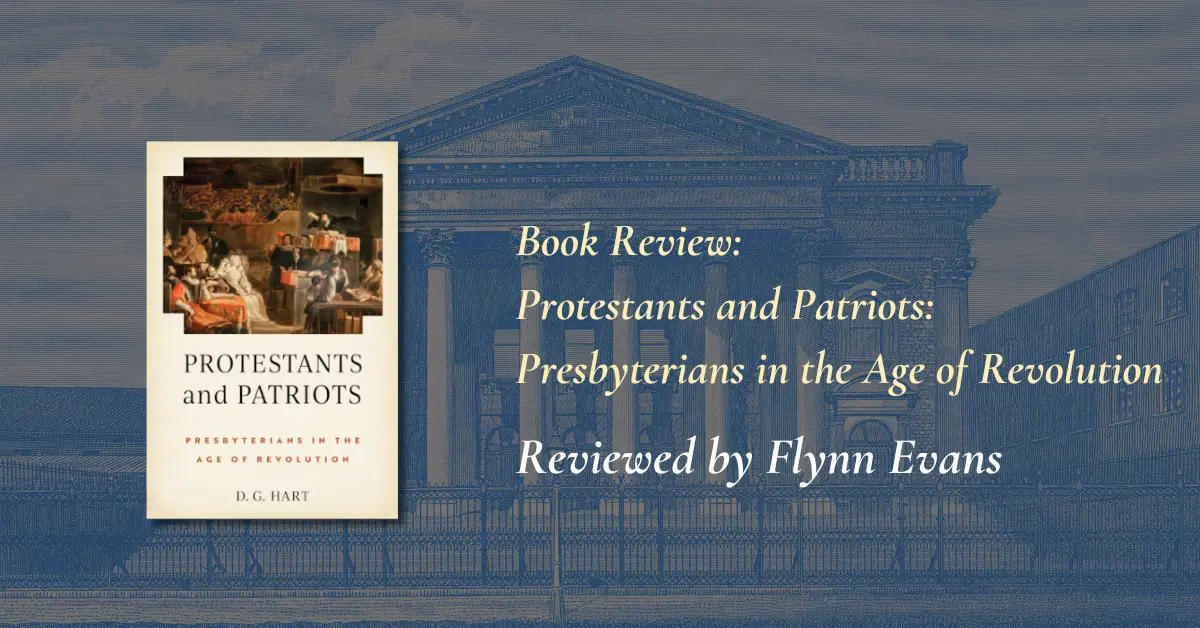
Presbyterianism invokes typically one of two images today: A paragon of theological progressivism or a dogged commitment to traditional Reformed theology and worship. The fact that such is possible in equal proportions is a testament to its own past. In Protestants and Patriots, D.G. Hart, an Associate Professor of History at Hillsdale College and longtime chronicler of Reformed Christian history, recounts how Presbyterianism would prove to be a potent force of change “in the Anglophone world…as an incubator of political agitation” that contributed to the historical justification for modern democratic government (11). Presbyterianism, beginning as a commitment to retrieve a more thoroughly biblical church polity, eventually became the mantle of Revolutionary ideology.
Yet Hart highlights how Presbyterians’ classical desire for a consistently “friendly magistrate” who would enforce their precise goals “proved to be Presbyterism’s Achilles’ heel” (16). Their early attempts at trying to fully implement their plans for church and state “became a lesson in the benefits of liberal politics” (16) by the late nineteenth century. Like many other movements, Presbyterianism, rather than operating according to an identity crystallized at its instantiation, learned to adapt while still claiming to champion the ideals of those of its predecessors. Debates surrounding the relationship between church and state both in Britain and in the United States inevitably served to shape the contours of Presbyterianism’s chosen expression depending upon its context and circumstances.
Part one documents Presbyterianism’s rise from the able, often vituperative penmanship of John Knox in Scotland and Thomas Cartwright in England to its more direct influence in Anglo-Scottish politics during the English Civil Wars, the Restoration period, and the aftermath of the 1688 Revolution. After Henry VIII ruptured the English Church’s communion with Rome in the 1530s, British Protestants across the ecclesiological and liturgical spectrum sought to defend how their singular visions for reform were in the best interests of the monarchy, the nation, and the Church of England as a whole. An outcome of the ecclesiological debates in which Presbyterians played a leading role throughout the sixteenth and seventeenth centuries was distilling the “temporal versus spiritual distinction” (35) that the Protestant Reformation introduced. In its break from Catholicism, Protestantism stressed the necessity of state authorities in enabling the proclamation of an adequately evangelical gospel from the pulpit and allowing for the carrying out of godly-minded church discipline. Any chance for realizing Presbyterianism’s lofty aspirations would ultimately come about not solely through pandering to the clerical elite but through appeal to the Supreme Head of the Church—the monarchy. In Hart’s reckoning, “Contrary to the shibboleth used to describe Presbyterianism, ‘no bishop, no king,’ the better quip arguably is ‘no crown, no Presbyterians.’” (105).
While English Protestantism was rendering more precarious positions such as divine right monarchy, they still needed the favor of earthly authorities to ensure that the biblical ideals to which they ascribed became a societal actuality. It was this period that solidified the perennial tension in which “Presbyterians…own views about a godly society and the need for a ruler” dedicated to rigorously upholding both public and private righteousness clashed with their simultaneous “insistence on the spiritual autonomy and sovereignty of church officers to run their own ecclesiastical affairs” (74). By the eighteenth century, “No one had yet figured out a way to maintain the luster of Presbyterian orthodoxy” when the particular sociopolitical contingencies that birthed it no longer predominated in the mainstream (132). Gone was the zeal for a godly Reformed commonwealth; in its place now stood the virtue-minded republicanism. The debate over Presbyterian identity at the turn towards the modern age had less to do with fundamental doctrinal commitments than with how they saw themselves either preserving or jettisoning their sectarian Protestant heritage.
Part two is perhaps where Hart’s own unique scholarly contribution is most noteworthy. Divergent recollections of early modern Presbyterianism’s struggles amidst the Tudors and Stuarts drove its inheritors in different directions. John Witherspoon in America and George Hill of St Andrews in the Church of Scotland rejected the polarizing dogmatism of the Scottish Covenanters in favor of “the emerging world of reason, tolerance, and social order” (174). Conversely, Samuel Miller of Princeton Seminary and the Ulster Scot-descended minister Stuart Robinson saw the United States as that which “finally allowed Presbyterians to voice, full throttle, the spiritual independence of the church” that they believed their forebears prioritized more than anything else (201–02). Few at this point were harkening back to the once widespread desire for a magistracy overtly zealous for exacting godly reform. A reconfigured sense of the two kingdoms doctrine enabled Presbyterians across the Atlantic basin in North America to make their peace with rapid modernization, even when such savvy likely “grew out of pragmatic considerations rather than ideals about the best or most godly society” (272). At the same time, commemorations and popular histories written by those with an overt preference for the confessionalized partisanship of yesteryear made themselves known at odd times throughout the 1800s. What Presbyterians of varying stripes still found themselves returning to though was a clear drive “to deliver a Protestant society,” be it “in the Old World or the New” (296).
Hart leans a bit too much on secondary scholarship when discussing English Puritanism, most notably David D. Hall’s The Puritans: A Transatlantic History, citing it no fewer than twenty times across the first two chapters. Despite acknowledging that “Presbyterianism should not be isolated from the literature on Puritanism, because both developed at the same time and were concerned to implement further reform in the national churches of England and Scotland” (311), only Patrick Collinson’s The Elizabethan Puritan Movement, Hall’s The Puritans, and Michael P. Winship’s Hot Protestants: A History of Puritanism in England and America make appearances in Hart’s bibliographic essay. Glaringly absent is the vitally important work of Peter Lake, whose monographs Moderate Puritans and the Elizabethan Church and Anglicans and Puritans?: Presbyterianism and English Conformist Thought from Whitgift to Hooker are essential for understanding the relationship between English Presbyterianism and Puritanism in the Elizabethan and early Stuart periods. Furthermore, categorization of them as respective “groups of Protestants” (311) betrays a lack of either awareness or appreciation for how Presbyterianism was inextricably linked with Puritanism itself. Hart’s descriptive appellations of certain individuals and movements as being moderate would also stand to benefit from a greater awareness that, as scholars such as Peter Lake and Ethan Shagan have shown, any presentation of moderation in early modern England was necessarily exclusionary in the early modern period. For instance, identifying Queen Elizabeth I’s position via insisting upon religious uniformity one of “moderation” (27) or Richard Baxter’s hoped-for “limited episcopacy” as being “in the moderate middle” (87) after the Restoration of the Stuart monarchy in 1660 neglects to appreciate the partisan singularity within such worldviews. The language of moderation in Tudor-Stuart England represented the tendency to, in the phrasing of Anthony Milton, “sugar the pill of painful compromise.”[1] Any ecclesiastical platform or proposed settlement was bound to prove dissatisfying and alienating in some form or fashion. A supposed via media was always ultimately intended to characterize alternatives as beyond the pale.
These historiographical deficiencies aside, the study retains clear strengths in its own right. It certainly facilitates a greater sensitivity to the reality of Presbyterian identity as far from monolithic at any given time. Hart’s focus on incorporating Ireland and Canada makes his saga genuinely transatlantic as well as Britannic. Additionally, he provides a very welcome and needed focus on the active role played by memory in history and how it factors into the construction of Protestant confessional identity. Far too often is the actual humanity of major theologians who succeeded their early modern predecessors downplayed when extrapolating from them. To understand how once eminent thinkers were just as susceptible to sentimentalism as we are is a needed corrective to those who would mistakenly do the same today. Hart excels in exploring how Presbyterians of later generations deployed often conflicting readings of history that served to advance their own agendas, often at the expense of those from the past they claimed to represent.
Hart’s principal intentions with this work, however, are not strictly academic but rather theological and cultural. His inquiry is intended to reprove both those who try to lionize Presbyterians as the principal architects of “the religious justification for the American Revolution” as well as others who would attempt to skirt around the extent to which Presbyterianism’s “assertion of the church’s spiritual independence and its elaborate and sometimes baffling explanation of the spiritual and temporal spheres of Christ’s rule were necessary features in building liberal politics” (306). Simply put, neither postliberal Christian Nationalists nor neo-Whig conservatives can have the final say when it comes to Presbyterianism’s legacy and identity in the twenty-first century. History of any kind is not meant to be decisive in settling matters of principle. Just as the proper fulfillment of the English Reformation was endlessly debated at its onset in the sixteenth century, so it remains the case with how its current inheritors seek to honor its memory amidst rapidly changing conditions as revealed by Hart here. The innate contestability of Protestantism is something that knows no geographic or historical boundaries. In that respect, very little has changed after all.
[1] Anthony Milton, England’s Second Reformation: The Battle for the Church of England, 1625–1662 (Cambridge University Press, 2019), 512.