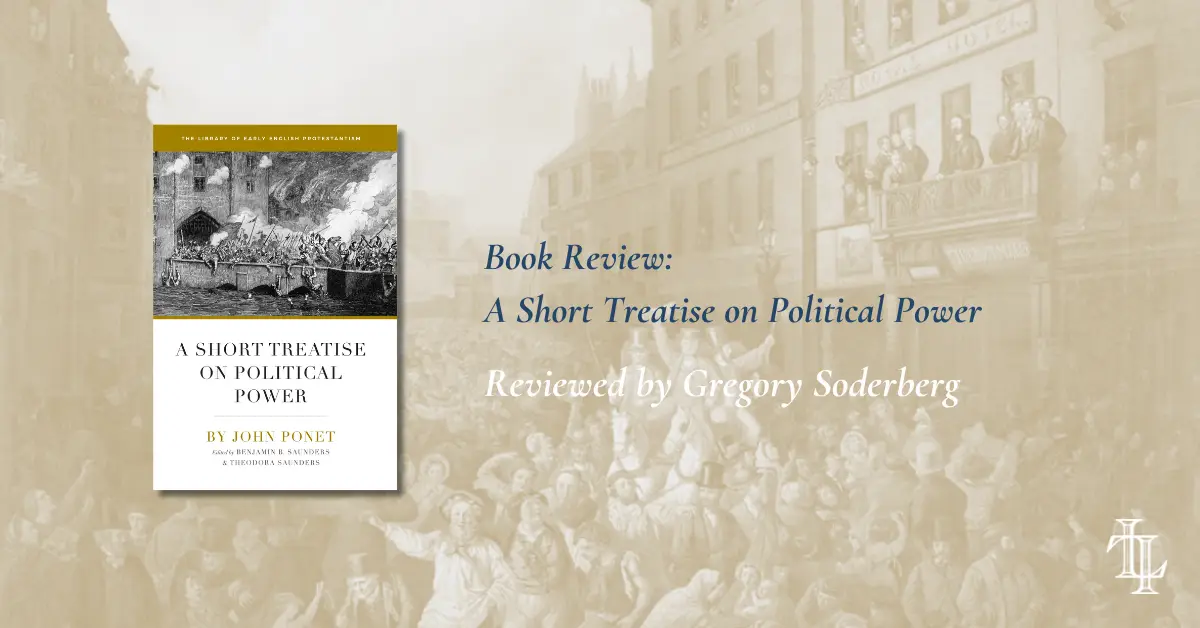
What has an English bishop to do with the American War for Independence? According to John Adams, much in every way. Although largely neglected now, John Ponet (1516-1556) was a widely respected bishop in the Reformation-era English Church. Adams claimed that Ponet’s treatise “contains all the essential principles of liberty, which were afterwards dilated on by Sidney and Locke” (xxx).
Who was John Ponet? During the “1540s and 1550s he was one of the most influential clergymen in England, trusted advisor to Thomas Cranmer, and influenced the course of the English Reformation. Ponet’s most important work, A Short Treatise of Politike Power, published in 1556, is widely considered to be a significant work in Protestant political theology which shaped Protestant thinking regarding civil power and resistance for generations, and impacted the American Revolution” (v). The editors of this volume, Benjamin and Theodora Saunders, have done valuable service in lightly modernizing the text of Ponet’s treatise and adding footnotes. They also include a valuabe introduction that summarizes the significance of Ponet and the main contours of his argument, and also provides a helpful background on early modern political theology.
There are eight chapters in Ponet’s treatise. Chapter 1 treats the origins and purposes of political power. Chapter 2 examines the question of whether political rulers have absolute authority and argues that they do not. Chapter 3 continues the theme and argues that civil rulers are accountable to God, as well as to the “positive laws” of their individual realm. Chapter 4 discusses the extent to which subjects must obey their political rulers, and Chapter 5 examines the limits of a ruler’s ownership of the goods in their realm. Chapter 6 lays down considerations regarding the propriety of deposing or executing unjust rulers. Chapter 7 outlines the limits of our trust in civil authorities. Chapter 8 closes the treatise with a pastoral “exhortation” and “warning” to the civil rulers of England.
Ponet grounds the necessity of government in humanity’s fallen nature. Because we cannot rule ourselves, we need external constraints (1). Additionally, he gives natural law a central place in his thought. God’s eternal rule is “the law of nature” which was at first “planted and grafted only in the mind of man,” but was later inscribed in the Decalogue, Ten Commandments, and summarized by Jesus into the two greatest commands in Matt. 22:37 and Mark 12:30-31. Ponet states that, “In this law is comprehended all justice, the perfect way to serve and glorify God, and the right means to rule every man particularly and all men generally, and the only stay to maintain every commonwealth” (2). This law applies to everyone, “be he king or beggar” (2). Earthly rulers were established by a God-ordained institutionalisation of the natural law (4).
In Ponet’s view, the particular form of law and government “is left to the discretion of the people to make so many and so few, as they think necessary for the maintenance of the state” (5). So, while God’s eternal law does not change, it can be expressed and enforced in a variety of ways in different contexts. Further, every form of government should only have one goal, namely “the maintenance of justice, to the wealth and benefit of the whole multitude, and not of the superior and governors alone” (6). When a government does not serve this goal, or when power was abused, “they altered the state” (6). Ponet presents a combination of both Biblical, theological, and historical (focusing on the classical world) examples throughout his treatise.
Ponet exhorts political rulers to integrity and honesty (8-9). For Ponet, it is axiomatic that God is the source of all justice, and will judge injustice wherever he finds it (11). Ponet denies that rulers have absolute power. This is important in the context of the developing theories of monarchy of the time. Since “princes are ordained to do good, not to do evil” (20), Ponet argues that “He is a good citizen who does no evil … but he is better who does not allow others to hurt or do injustice to others” (25). He concludes: “[K]ings, princes, and governors of commonwealths have not, nor can justly claim, any absolute authority, but that the end of their authority is bounded and certain to maintain justice, to defend the innocents, to punish the evil” (25).
What limits, then, are placed on the authority of political rulers? In chapter 3, Ponet maintains that they “are subject and ought to be obedient to God’s laws and word. For the whole Decalogue and every part thereof is written as well to kings, princes, and other public persons, as it is to private persons” (27). In fact, rulers are twice as obligated to obey God’s laws, both as a private person and as a public office bearer (28). Ponet argues, in addition, that rulers must obey the “positive laws” of their own countries (30).
Ponet’s project is twin-pronged: he rebukes political rulers who would claim more power and authority than is given by natural law, God’s Word, and the positive laws of a realm, while also resisting and rebutting the over-arching claims of the Roman Catholic church (31). In essence, he undermines the over-weening “divine right” theories of English monarchs, while also reinforcing the foundations of the English Reformation movement.
Ponet’s balancing act is further demonstrated when he states that there must not be “too much” or “too little” obedience given to political rulers (37). “Too much” leads to tyranny, and “too little’ leads to “licentious liberty” (37). Ponet argues that we must obey civil rulers when they command us to do things consonant with God’s character and revealed law, but must refuse to obey when they command us to do things that conflict with God’s character and law (42-43).
Ponet argues that it is justifiable to flee from persecution and tyranny, citing Matt. 10:23 and the example of Jesus himself, who went into Galilee after the execution of John (60). However, he stresses the primary obligation to suffer while also trusting in God, as a primary duty when disobeying unjust rulers (60, 62-63). In this, he distances himself from any revolutionary urges–Christians should not rise up and protest, or revolt, as a first response to unjust rulers. We must obey God rather than men, certainly, but we must also be willing to suffer for the sake of Christ as we disobey men.
Chapter 5 deals with the limits of a ruler’s ownership. For Ponet, the validity of private property is grounded in the commands against stealing and against coveting (66). A Christian king is “not exempt from the laws and duties of a Christian man which everyone professes in baptism” but should rather excel all others in his devotion to duty and keeping the law” (74).
Chapter 6, on whether it is lawful to “depose an evil governor and kill a tyrant,” is probably what gave Ponet his fame (or infamy) during subsequent events, especially in the American War for Independence. Ponet states that the natural law “testifies to every man’s conscience that it is natural to cut away an incurable member which (being allowed) would destroy the whole body. Kings, princes, and other governors, although they are the heads of a political body, yet they are not the whole body. And though they are the chief members, yet they are but members; neither are the people ordained for them, but they are ordained for the people” (90).
However, Ponet qualifies these assertions and states that, “it cannot be maintained by God’s Word that any private man may kill, except (where execution of just punishment upon tyrants, idolaters and traitorous governors is either by the whole state utterly neglected, or the prince with the nobility and council conspire the subversion or disorder of their country and people) any private man has some special inward commandment or surely proved motion of God, as Moses had to kill the Egyptian, Phineas the lecherours, and Ehud King Eglon, with such like; or otherwise commanded or permitted by common authority upon just occasion and common necessity to kill” (93).
If political rulers do not rule justly, Ponet expects ministers to stand up to political authorities and rebuke them when appropriate, and even excommunicate them when necessary. But what if the minister fails to “speak truth to power”? Ponet admits there are Biblical examples of individuals who seem to oppose tyrants, even to the point of assasination: Ehud (Judges 3) Jael (Judges 4) and Mattathias (1 Macc. 2). Ponet draws back from recommending these actions without qualification. He merely states: “These examples need no further exposition, the Scripture is plain enough” (102). He seems to leave the matter between the individual and God. Might God raise up another Ehud? Yes. Are you that Ehud? Maybe, but not so fast!
In the end, Ponet counsels prayer and penance when all else fails. He does not call for rebellion or revolution (102-103). But this is no empty consolation. Ponet cites examples of the power of prayer and repentance throughout the Scriptures and history (103-104).
Ponet’s “short treatise” is a helpful summary of English Reformed political theology. Ponet is at his best when he deals with principles, whether of natural law or of Scripture. There is a good deal of material specific to his polemical context, especially his tangles with Stephen Gardiner and other leaders of the English Catholic movement.
Ponet writes with a typical 16th century assurance that much of the Old Testament can be easily transferred and applied. Israel = Reformed England. This is not unique to Ponet–this is simply how early moderns read the Bible. (This is probably part of human nature. How many contemporary evangelicals lift their favorite proof-texts out of their original contexts?)
Ponet assumes that civil rulers will be concerned about the practice of pure religion in their realm. Again, this was shared throughout most of early modern Europe. The only question was–which religion?
Ponet provides a useful treatment of both the Biblical foundations of political power, as well as some striking guidelines on the limitations of that power. One can see why John Adams would have praised him so highly when he speaks of the possibility of resisting and even overthrowing a tyrannical ruler.
Graduate students, pastors, and interested readers will find much food for thought here. If recent debates about “Christian nationalism” and the church’s role in the public square have revealed anything, it is that most Americans, and most Christians, have reflexive and shallow understandings about political theology. In this context, it is useful to read sources further removed from our own situation. Ponet provides a Protestant, principled, Biblically-informed, treatment of political power. There is much in his treatise that can help move current debates forward. Our generation is not the first to struggle with questions of the limits of political power, or to wrestle with a faithful Christian response to the abuses of power. Ponet does not fit neatly within any of our current “boxes,” which is all the more reason to read and profit from this republication of his work.