Editor’s Note: This Book Review is part of our Biblical Covenants and the Conflict in the Middle East series, in which we bring together scholars with differing views on the relationship between the Biblical covenants and examine how their views affect the current conflict in the Middle East. Be sure to check out the next article on Progressive Covenantalism, which will be released in the coming weeks.
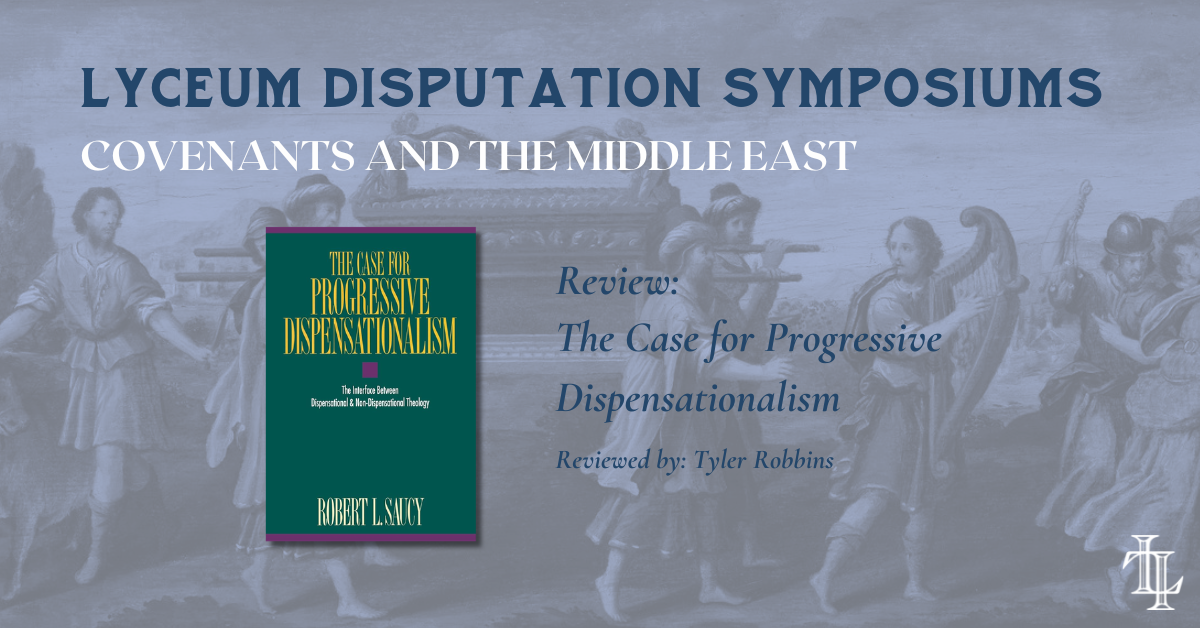
The late Robert Saucy was a longtime professor of systematic theology at Talbot Theological Seminary. He was one of the movers behind “progressive dispensationalism”—a revision to the traditional dispensationalist system spurred by “increasing dialogue” with the other side (8). He published this work in 1993, and by 1995 Charles Ryrie (the “grand old man” of an older version of the system) was warning that Saucy (et al) introduced a “revisionist” and “complementary hermeneutic” that confused Israel and the church because of its “slippery nature.”1Charles Ryrie, Dispensationalism (reprint; Chicago: Moody, 1995), ch. 9.
Saucy presents his case with relentless logic.
Progressive dispensationalism is a “mediating position” that still insists on a distinction between national Israel and the church, but integrates this future for Israel into a unified plan (ch. 1). There is continuity, not discontinuity (28).
The Abrahamic covenant promises a land, a seed, and a blessing for its adherents (ch. 2). Gentile participation in the new covenant fulfills the “blessing” promise—not the seed promise. Further, there is “some indirect witness” to the continuing validity of the land promise, which the seed will inherit (49-50, 58)
In ch. 3, Saucy declares the Davidic covenant advances God’s plan—elaborating the Abrahamic covenant (62) by promising David a permanent dynasty and kingdom (59). Jesus fulfills this in the new covenant but never negates the promises to national Israel (63). This dynasty will ultimately be a physical lineage in a political kingdom. What (based on old covenant evidence) seemed like one fulfillment is actually two. While Jesus is at the right hand of God, he is not reigning now in the old covenant sense (75)—we see today “only an initial fulfillment of the covenant promises during the present age” (80).
Ch. 4 tells us: “the kingdom of God on earth is, in fact, the ultimate goal of biblical history” (81). To be sure, Jesus spoke of “the kingdom” in diverse ways, but he never abrogated its nationalistic elements (86). The new covenant simply reveals a heretofore unknown “two-stage” fulfillment. While the spiritual aspect is here now, we await the physical and political elements of “kingdom” in the restoration of national Israel (89). So, it is inappropriate to speak of Jesus “reigning” over his kingdom now (101, 106).
Gentile inclusion does not “transform” the old covenant promises (ch. 5). Rather, the Gentiles are “the many” and “the nations” spoken of in the Hebrew scriptures (esp. the Isaiah 53 prophecy), which suggests the nations are parties to the new covenant alongside of Israel—they are not the same (130-134). Moreover, the bible never applies the material provisions of the old covenant promises (restoration of Israel to the land, rebuilding of the cities, increased productivity of the earth) to the church (134).
Ch. 6 discusses the “mystery of the church,” and Saucy concludes that passages such as Ephesians 2 and 3 do not say there is a “new Israel.” Rather, there is a new “heavenly commonwealth” that is not Israel “and yet has a close historico-redemptive relationship with Israel” (qtd. at 161). This is the church, and God never revoked his old covenant promises to Israel (165).
In ch. 7, Saucy tackles an in-house dispensational debate about baptism of the Spirit and the new covenant.
In ch. 8, Saucy explains that the “people of God” are Israel and the church (190). Saucy deals with passages such as Romans 2:29, Galatians 3:23, 6:16 (“and the Israel of God”); Philippians 3:13, 1 Peter 2:9-10, and others. Israel is a nation, which means race, government, and territory (192). The church is not a nation (“[q]uite clearly the national element is lacking in the concept of the church in the New Testament,” 194), and so it cannot fulfill Israel’s nationalistic evangelism program foretold by the prophets (218).
The old covenant prophesies, Saucy avers (ch. 9), cannot be denied. They promise a final restoration from exile, Israel restored as a nation under a Davidic king, Jerusalem as the glorified center of a universal kingdom, the spiritual renewal of Israel, salvation for the nations of the world, the return of paradise, and a final state of perfection beyond a millennial kingdom. These prophecies are comprehensive and holistic, they remain unfulfilled, and they depict a historical fulfillment “in concrete earthly reality … and was apparently so understood by the faithful of God’s people” (243, 244).
Romans 9-11 (ch. 10-11) is irrefutable evidence that national Israel has a future. Divine judgment does not mean forfeiture of the divine promises, and “the main elements of the eschatological picture of the Old Testament remain intact, including a future for the nation of Israel along with the blessing of all peoples” (246). He declares: “There can be no stronger affirmation of the continuance of the Old Testament covenanted promises to the nation of Israel than this one in Romans 11 …” (250).
Israel must fulfill her promised roles (ch. 12). She was prophesied to be the channel of divine revelation, and the mediator of a ministry of salvation to the world (311). Ezekiel and Isaiah focus extensively on these issues, and they envision a socio-political salvation era in concrete reality (305). “Given the nature of this salvation—i.e., socio-political—we affirm that the mediatorial ministry of witness and proclamation is best fulfilled through a real nation, the restored nation of Israel” (323).
This book covers substantial ground and champions its perspective well. At least four issues deserve attention.
- First things
To agree with Saucy, you cannot believe the new covenant reinterprets the old. Does knowledge of an entire movie re-shape how you understand a crucial scene back at the halfway point? What about a detective novel? Say you finish the book and now know who the killer is, and know that he was steering the police investigation astray the whole time—do you not now flip back to this or that passage and read it in a new light—its true light? Do you “see” or understand things you could not, before? Saucy says no, despite his attempts to soften this blow (33, 245).
This “new covenant does not reinterpret the old covenant” principle undergirds everything. God means what he says. This is why, on Saucy’s view, God will surely make good on his covenant pledges to Israel— the land + seed promises of a nation state in concrete reality, with David’s “son” reigning over a political kingdom, Israel fulfilling her prophesied role in bringing salvation to the nations. So, Saucy always interprets new covenant passages in this light.
For example, Romans 2:29 does not say that a true “Jew” is one who has true faith—that a real believer (be he Azeri, Turkish, or even … Canadian) who is circumcised in heart is part of “Israel.” No—Paul says there are false ethnic Jews and true ethnic Jews, and the true ethnic Jew is one who has genuine faith (198). Paul, Saucy declares, certainly does notre-define what “Israel” means here or anywhere else.
Likewise, the conjunction at Galatians 6:16 (καὶ ἐπὶ τὸν Ἰσραὴλ τοῦ θεοῦ) is a simple additive (“and upon the Israel of God”)—Gentiles are full partners in the new covenant, not usurpers (200). Certainly, Philippians 3:3 says that true Gentile believers are “circumcised” in heart, but we expect this—they are parties to the new covenant promises! “But the absence of a spiritual distinction does not mean there are no distinctions at all. Nowhere in discussions of ‘spiritual circumcision’ does Scripture explicitly specify Gentiles as ‘Jews’ or the church as a ‘new Israel’” (204-205).
This pattern repeats throughout Saucy’s work, and back of it all is this hermeneutical presupposition.
- Mistaken emphasis?
God made promises to national Israel, and he means what he says. Period. So, according to Saucy, the climax of God’s plan is the millennium as the fulfillment of God’s promises to Israel: “the kingdom of God on earth is, in fact, the ultimate goal of biblical history” (81). This is the progressive dispensational distinctive (20, 27-28). Dispensationalism stresses the millennium—not the eternal paradise in Revelation 21-22.
Of course, Saucy speaks of eternity (110), but it is clear his emphases are the millennium, and the matrix of covenant promises to Israel. He consistently acknowledges eternity, then says “yeah, but …” and quickly pivots to the millennium (e.g., 292). Yet, in light of the entire Christian story, the millennium is not the ballgame—eternity is. While the millennium is surely important, some would argue this is like gleefully anticipating your wedding rehearsal more than your wedding night.
- Taking fire from all sides
Saucy is in a difficult position. He has two audiences—he wants to address critique from non-dispensationalists and fly the (modified) dispensationalist flag at the same time. So, he spends much time fearfully looking over his shoulder for Ryrie (et al), waiting for an ambush he knows is coming. He fights rear-guard actions, tiptoes halfway towards “traditional” views, then halts and waves his dispensationalist flag. So, he pleases nobody and frustrates everybody. Ryrie still warns of sedition and betrayal, while covenant theologians smile awkwardly and agree that, yes, dispensationalists are getting closer to the kingdom.
- When you’re right, you’re right
Saucy marshals a very impressive case to take the old covenant promises seriously (see ch. 9). Together, these prophesies forecast a final restoration from exile, Israel restored as a nation under a Davidic king, Jerusalem as the glorified center of a universal kingdom, the spiritual renewal of Israel, salvation for the nations of the world, the return of paradise, and a final state of perfection beyond a millennial kingdom. Can we really gainsay all these prophecies with talk of typology or citations of Romans 2:29, Galatians 3, and 1 Peter 2:9-10?
Then there is Romans 11, which this reviewer (and Douglas Moo,2Douglas Moo, The Epistle to the Romans, in NICNT (Grand Rapids: Eerdmans, 1996), 537-739. John Murray,3John Murray, The Epistle to the Romans, in NICNT, vol. 2 (Grand Rapids: Eerdmans, 1965), 89-100. and Leon Morris4Leon Morris, The Epistle to the Romans, in PNTC (Grand Rapids: Eerdmans, 1988), 418-26.) finds definitive regarding a future for national Israel. Although some may fear to sidle any further towards Saucy here (“rather than a transformation, the passage itself gives evidence that Paul clung to the basic hope offered in the Old Testament picture,” 259-60), dispensationalism’s critics must somehow reconcile national Israel (and Romans 11) into their system.
If Saucy is correct about the old covenant shape of national Israel’s future hope and role, then it follows that national Israel has a crucial role to play in a future millennium, in a concrete socio-political reality, and therefore the church cannot be synonymous with “Israel”—and so the one new covenant people of God consists of two distinct parties with complementary roles. Whether Saucy (and dispensationalism) is correct to put its system’s major emphases on the millennium and Israel’s role in it is still open to question.