Editor’s Note: This Book Review is part of our Biblical Covenants and the Conflict in the Middle East series, in which we bring together scholars with differing views on the relationship between the Biblical covenants and examine how their views affect the current conflict in the Middle East. Be sure to check out the next article on Progressive Dispensationalism that will be released in the coming weeks.
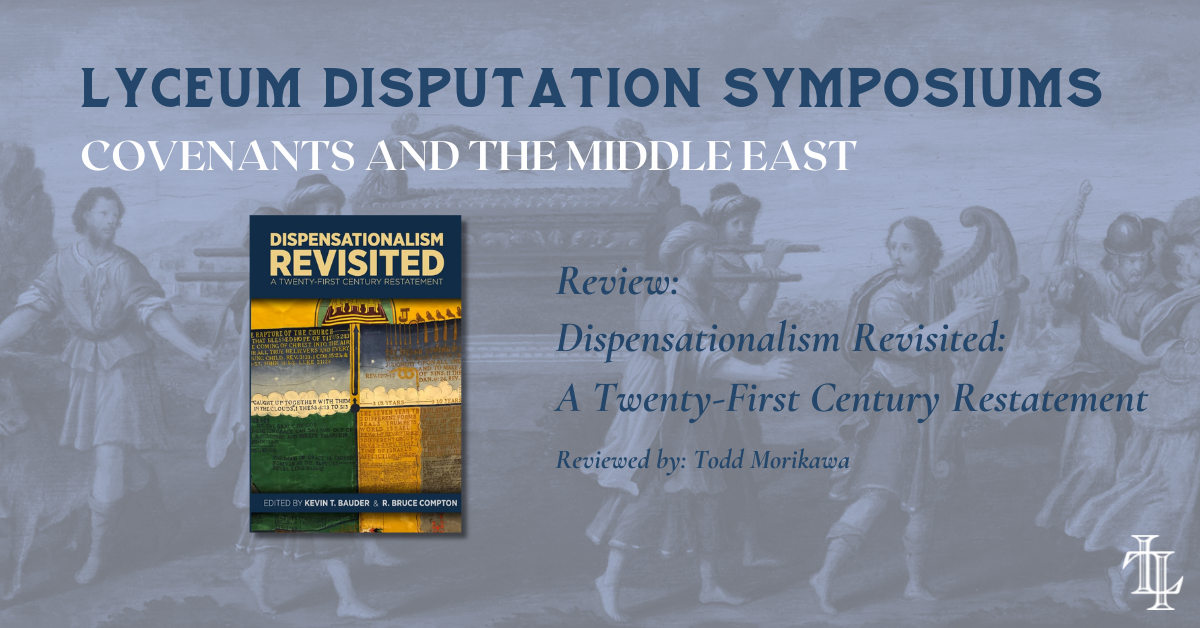
Kevin T. Bauder and R. Bruce Compton have edited a helpful volume for anyone who wants to understand the best of Dispensationalism today. Bauder is Research Professor of Systematic Theology at Central Baptist Theological Seminary. Compton served for 41 years as a professor of Biblical Languages and Literature at Detroit Baptist Theological Seminary. Both men are well-equipped to edit this work, and both men contributed essays in this book.
Dispensationalism Revisited is a Festschrift in honor of Charles A. Hauser, Jr. (1931–2022), a renowned teacher of Dispensational theology for over 50 years at both Denver Seminary and Central Baptist Theological Seminary. Hauser had a great impact on all ten contributors to this volume and, as this book attempts to do, “argued for traditional dispensationalism” (13) with a willingness to depart wherever older theologians went wrong. Though there are ten essays, Bauder believed the first three chapters are “the heart of the book” (15). Therefore, I will engage most deeply with those three chapters, then give a brief overview of the other seven essays, followed by a brief conclusion.
Summary of Douglas Brown chapter
Brown, Biblical Studies chair at Faith Baptist Theological Seminary, wrote the first essay on one of Charles Ryrie’s three sine qua nons of Dispensationalism. Ryrie’s essentials were consistently distinguishing between Israel and the Church, a literal hermeneutic, and a focus on showing that “the underlying purpose of the world is the glory of God” (15). This essay focused on the last.
Many Dispensationalists have debated whether the glory of God is distinctive to Dispensationalism at all (18). Brown gave seven premises to indeed display the glory of God as both the unifying theme of Scripture and a sine qua nonof Dispensationalism (20–30). He concludes that “Dispensationalists need to do a better job recognizing that other theologians with other theological systems (such as covenant theology and progressive covenantalism) do uphold God’s glory as creation’s chief end,” (31) but what makes Dispensationalism’s approach to God’s glory unique is that it sees the restoration of Israel to a theocratic kingdom in the Millenium as one of the climaxes of God’s glory being manifested.
Critical engagement with Brown
Brown’s essay is an edifying chapter, as any meditation on the glory of God will be. He does well to show the diversity among Dispensationalists on the question of a unifying theme in Scripture. He also displays humility in acknowledging his work is just “the start of a biblical theology of God’s glory” (20). The way he lays out his seven premises gives the chapter great organization and ease of reading. His willingness to call out Dispensationalists for not recognizing that other theologians also see the glory of God at the center of Scripture is a refreshing display of honesty.
There are, however, two main things to critique. First, Brown’s concept of theocracy could use more development. He wrote, “God at various times has manifested his rule on the earth through a mediator or representative. This aspect of God’s kingdom is the theocratic or mediatorial kingdom. The theocratic rule of God started in Eden with Adam” (29). He sees Adam as a mediatorial ruler in the Garden and equates that on some level with theocracy. This is fundamental to Brown since the next theocracy he sees in Scripture is Israel (29), which makes the re-establishment of Israel in the future fundamental to God’s theocratic program for the earth. For Brown, a theocracy happens when the Kingdom of God is visible on the earth. Questions arise when Brown states that “Jesus will rule God’s theocratic kingdom over all nations of the earth from David’s throne in Jerusalem” (29, emphasis mine). Is a theocracy one nation? Is Israel one of the nations included in Jesus’ theocratic kingdom? Who is the mediator for Israel? Moses? Jesus? Was it proper to refer to Israel as a theocracy before the institution of Saul? Would it ever be proper to call the Church a theocracy since non-Dispensationalists believe Jesus to be their mediatorial king who will one day rule physically over them upon a new earth? If not, why not? Brown may have great answers to all these questions, which is why it probably deserves more treatment given the foundational nature of the theocracy claim.
The other critical flaw is that only one of the premises, the seventh of the seven, is truly distinct to Dispensationalism. Brown realizes this, yet he nonetheless presents these as all essential to his system of thought. His seventh premise is that God’s ultimate glorification only occurs “as he fulfills the national promises to Israel in the millennium” (28). His clarity there at least shows the uniqueness of Dispensationalism’s view of God’s glory. However, if Dispensationalists remain true to that claim, then they must accept when critics fear that Dispensationalists contradict God’s plan to completely manifest his glory in the church (Eph 3:9, 20).
Summary of Roy Beacham chapter
The second essay in the book is written by Roy Beacham, an Old Testament scholar, who argues for the Dispensationalist literal hermeneutic to be applied consistently to the predictions of Old Testament Prophets. Beacham believes Covenant Theology, Progressive Covenantalism, and Progressive Dispensationalism all accept on some level the idea “that predictive prophecy can be, has been, and is being fulfilled in some other way than literally” (35). Beacham sets out to reaffirm that all genuine prophecy must be understood literally.
Beacham’s fundamental argument is that there must be “perfect, self-evident parity between every forecast of future events and every outcome of each event” (40) and “any form of other-than, less-than, or more-than-literal fulfillment” of God’s predictions amounts to the knowledge of false gods (41). The comparison to false gods is based on God’s unique ability to tell the future, so any fulfillment that is not literal can look like incorrect knowledge of the future. Beacham then argues that the ground of predictive prophecy is the absolute perfections of God, who is immutable and whose speech effects exactly what it intends (41–51). The next section shows that predictive prophecy, largely based on Deuteronomy 18:15–22, is univocal in nature (51–60), leading Beacham to state, “the interpreter cannot drive a wedge between the prophet’s words and God’s words because the words spoken by the prophet were the very words of God, no more and no less” (59–60). The chapter ends by asserting that predictive prophecy functions as discernable truth leading to discernible response (60–63), and the test of prophecy is whether it comes to exact fulfillment or not (63–66).
Critical engagement with Beacham
Beacham presents the Dispensational hermeneutic with clarity and continued charity. He forces readers to deal with many texts of Scripture, something to consistently commend among Dispensationalist writers and preachers. Beacham displays an exemplary desire to take every word that comes from the mouth of the Lord seriously.
The literal hermeneutic is foundational to Dispensationalism and the following engagement will focus on the meaning of literal fulfillment. Beacham’s view of literal fulfillment is that there must be “perfect, self-evident parity between every forecast of future events and every outcome of each event” (40). The major issue here is what “self-evident” means. He says right before this that a biblical prophecy can only be validated “if everything that God foretells actually comes to pass precisely as foretold” (40). The meaning of a passage must be self-evident, the fulfillment of the passage must be a self-evident fulfillment, and the precision of the fulfillment must be self-evident. The problem lay in the subjective nature of what constitutes “self-evident.”
One of Beacham’s examples of self-evident, precise fulfillment is that Isaiah 45:1 specifically names Cyrus as one who will “subdue nations” (45). For Beacham, the fact that a literal man named Cyrus rose to power over a century later is evidence that the nature of all predictive prophecies and fulfillments is exact, precise, and self-evident. However, non-Dispensationalists do not dispute that many prophecies are fulfilled in the exact way Beacham believes they would be. The question is if those same prophecies can ever have greater fulfillments than what the Dispensationalist is looking for—fulfillments that no human author could possibly predict.
Beacham appears to contradict himself unwittingly when he wrote, “The prophet may have fully understood the prediction he announced on behalf of God (1 Kgs 22:17, see 22:28) or the prophet may have found the forecast utterly perplexing (Dan 7:15–16)” (55). It seems contradictory on one hand to say that prophecies must be self-evident yet, on the other hand, to say that a prophecy can be utterly perplexing. It is reasonable to assume that Daniel’s prophecy was beyond Daniel’s understanding due to the divine omnipotence. In other words, there was a self-evidentunderstanding of Daniel’s prophecy and at the same time an understanding that only the divine mind could know.
This chapter might have been stronger if Beacham addressed examples of passages that appear difficult for Dispensationalists to approach in a way consistent with their professed hermeneutic. For instance, Genesis 3:15—the very first predictive prophecy—appears to be a prediction that Dispensationalists do not interpret in a literal way. The self-evident interpretation of “he shall bruise your head, and you shall bruise his heel” is not that a God-man would die on a wooden cross to once-and-for-all pay for the sins of the elect. This conversation could move forward if Dispensationalists could show how their hermeneutic squares with passages like this
Summary of Bauder chapter
The chapter written by Kevin Bauder engages with the absolute essential of Dispensationalism, namely, the distinction between Israel and the Church. He believes non-Dispensationalists have misunderstood the way Dispensationalists use the term “people of God” and have been unnecessarily harsh because of it (72). Bauder sees “nation” and “people” in Scripture normally tied to devotion to a certain god or gods (74). For Bauder, ethnic unity is a key part of what makes a people of God a people. God promises that many ethnic peoples will turn to him in the future (77). Israel was the first “people of God” in Scripture and has a secure future as the people of God (79–83). The Church is a spiritual people with a spiritual ancestry; they are a true people of God, but a “different kind of people” because of their union with Christ (84–85). In the Church, ethnic unity is replaced by spiritual unity. In the future there will be Israel, the Church, and many other nations standing as peoples of God (87).
The reason the New Testament applies texts that were meant for Israel to the Church is because there remains continuity between Israel and the Church (89–91). It is not that Israel and the Church are the same people but rather that they are analogous peoples; it is a continuity of analogy. Bauder raises the issue of the Church being the true Circumcision according to Philippians 3:3, then shows that circumcision throughout Scripture points to spiritual circumcision, which is regeneration (95–97). Regeneration has always been for all peoples. In the future, God will give regeneration to the entire nation of Israel, and during the Millenium, many other nations will receive this gift (99). There will be many peoples of God, but the distinction of Israel as the first people will always remain.
Critical engagement with Bauder
Bauder’s explanation of “people of God” in Scripture is clear and helpful for understanding Dispensationalism. Hopefully, non-Dispensationalists will never charge Dispensationalists with teaching multiple ways of salvation just because they teach there are multiple peoples of God. Bauder’s irenic tone throughout makes this chapter readable, enjoyable, and respectable.
My question is about the validity of Bauder’s explanation of the relationship between Israel and the Church. The problem surfaces when Bauder explains that God “broke down the barrier between Jew and Gentile and somehow made both into one” yet “Romans 11 turns on a continuing difference between Israel and the Gentiles” (86). There appears to be a confusion of categories when Bauder rightly distinguishes between Jew and Gentile in one breath but then wrongly distinguishes between “Israel” and Gentiles in the next.
He aligns with all non-Dispensationalists in articulating the glorious reality of Jew and Gentile being “united under a new identity and given a new solidarity” (86). For Bauder, the Church is the one new humanity of Jew and Gentile believers. When speaking of the olive tree in Romans 11, however, he thinks it is distinguishing between “Israel” (Jewish believers) and Gentile believers (the Church minus Jewish believers). One might think that Bauder is, according to his own categories, seeing Romans 11 as distinguishing between Israel as a people of God and many Gentile nations as peoples of God. Yet he betrays his theological commitments when he says that “both Israel and the church are branches from a common root (Romans 11:16–25)” (90, emphasis mine). Bauder does not see Romans 11 as merely distinguishing between Jewish Christians and Gentile Christians but rather distinguishing between Jewish Christians and the Church defined as Gentile Christians. Dispensationalists appear to sometimes contrast Jew and Gentile, sometimes contrast Israel and Church, but sometimes contrast Jew and Church. The last contrast introduces an unbiblical distinction between Jewish Christians and the very institution Bauder believers they are a part of.
Bauder should be commended for bringing up many relevant passages such as 1 Peter 2:9–10, Romans 2:23–29, and Philippians 3:3. In every case, Bauder interprets them in such a way that “Israel remains Israel, and the church remains the church” (92). Besides the aforementioned confusion of categories, one wonders how could God say that the Church is the True Israel if he wanted to? If the church is a “holy nation” (1 Pet 2:9) but that does not mean they are True Israel, and if a Gentile Christian is a “Jew [that] is one inwardly) (Rom 2:29) but that does not mean they are a True Israelite, and if Christians are “the circumcision” (Phil 3:3) but that still does not mean they are True Israel, is there any possible way to articulate that Old Testament Israel is the Old Testament Church and that the New Testament Church is New Testament Israel?
Let me be clear that I believe Bauder is interpreting these texts exactly how a Dispensationalist should interpret these texts. But what Dispensationalists should acknowledge is that they are interpreting these texts based on their pre-commitments to Dispensationalist theology. In fact, Bauder attempts to address Scriptures that are often interpreted by his opponents “as if the church has actually replaced Israel” (92). The very concept of “replaced” is a Dispensationalist category. Bauder rejects replacement theology because he presupposes that his understanding of Old Testament texts is beyond dispute, but I believe the way for this conversation with Covenant Theologians to move forward is to not discuss replacement but rather if replacement is a legitimate category.
Summary of last seven essays
William Barrick wrote the fourth essay on biblical covenants and their fulfillment. He summarizes the six covenants that Dispensationalists believe God made with Israel. The fifth essay, by Compton, is a study of the term “Kingdom of Heaven/God” and its relationship to the Church. Compton argues that the Kingdom is a future, earthly reality and that believers do not presently experience it, though their place in it is secure. Essay number six, by Larry Pettegrew, is a survey of early church fathers and their view of Israel. Though they were not pretribulational, they were all by and large Premillennial. Andrew Hudson, in the seventh essay, presents a Dispensationalist reading of the book of Acts. Acts is a transitional book in redemptive history but never negates any teaching about a future restoration of national Israel. Ryan Martin’s essay on the issue of Supersessionism is a Dispensationalist reading of Romans 9–11. The main argument is that the Apostle Paul was not teaching that many Gentiles are included in “Israel” but rather that many Jews are not included in “Israel.” W. Edward Glenny wrote the ninth essay on whether Jesus will return before the Millenium, an exposition of Revelation 20. He shows why Dispensationalists see Revelation 19 and 20 as necessarily sequential. Lastly, Jonathan Pratt wrote a case for a pretribulational rapture. He acknowledges diversity among Dispensationalists but then shows how several NT texts harmonize well with the rescue of the Church before divine wrath is poured out on the earth.
Conclusion
Dispensationalism Revisited is well-organized, with each chapter building upon the previous. Every pastor and seminary student can utilize this book to understand the best of Dispensationalism. The clarity with which the authors write makes it easy to understand what they believe, why they believe it, and where you may disagree. That kind of writing is worthy of imitation.
The book ends with several reflections on the life of Charles Hauser. It is clear he modeled Christ well for his students and colleagues. Despite my personal disagreements with many of the writings here, I wholeheartedly affirm the character of Hauser and his theological associates. The debates raised in this book are family debates.