Editor’s Note: This Book Review is part of our Biblical Covenants and the Conflict in the Middle East series, in which we bring together scholars with differing views on the relationship between the Biblical covenants and examine how their views affect the current conflict in the Middle East.
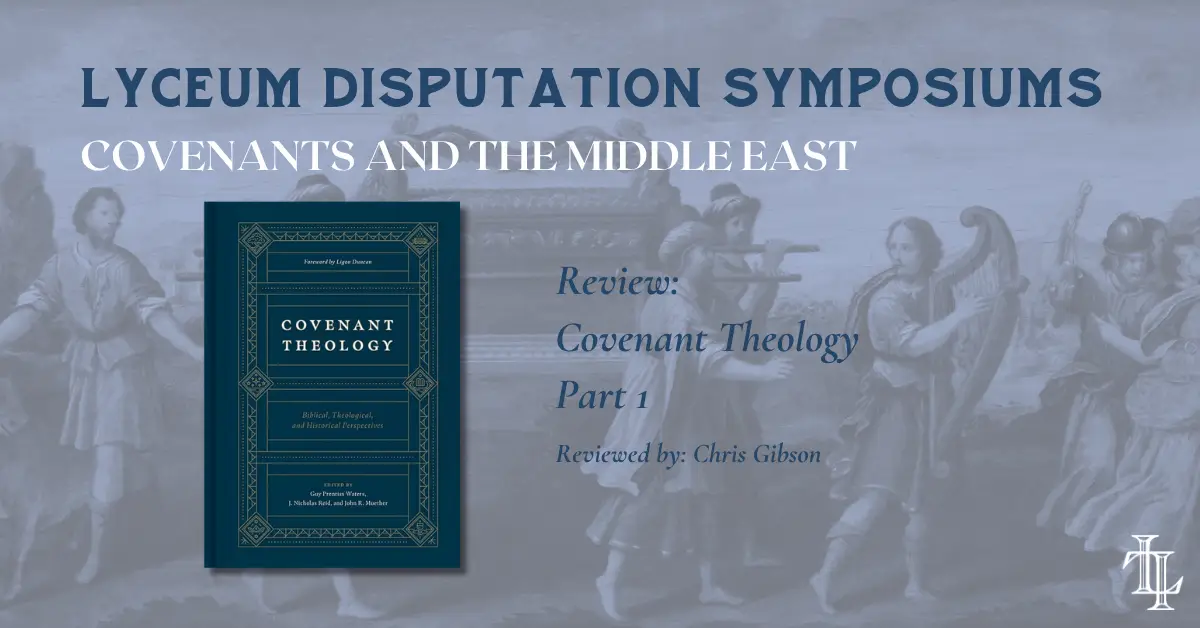
This is the first installment in a three-part review of Covenant Theology: Biblical, Theological, and Historical Perspectives—edited by Guy Prentiss Waters, J. Nicholas Reid, and John R. Muether. Waters and Reid serve as professors of New Testament and Old Testament, respectively, at Reformed Theological Seminary, while Muether is the seminary’s librarian and a church historian. The volume is the work of twenty-six contributors, the large majority of whom are current or former faculty members of Reformed Theological Seminary (RTS), a confessional Presbyterian institution with campuses across the United States dedicated to training pastors and scholars committed to the authority of Scripture and the Reformed faith.
In their Introduction, the editors explain that the volume seeks to demonstrate that classic Reformed covenant theology is not an artificial scholastic grid imposed upon Scripture, but rather arises organically from careful, canonical exegesis as the very architecture of God’s redemptive plan (25–29). They note that while many evangelicals affirm that God relates to his people covenantally, the Reformed tradition develops this insight with particular depth, organizing redemptive history around the eternal covenant of redemption, the covenant of works with Adam, and the one unfolding covenant of grace. The book is the collaborative work of twenty-six contributors, nearly all of whom are current or former faculty members of Reformed Theological Seminary. Written from a self-consciously confessional perspective aligned with the Westminster Standards, the volume aims to serve the church by presenting covenant theology as exegetically responsible, theologically rich, and pastorally fruitful. As Ligon Duncan notes in the Foreword, the triune God has always related to his people through covenant, making this subject essential for understanding the unity of Scripture and the glory of salvation in Christ.
Part One of this substantial volume delivers a robust, exegetically grounded exposition of covenant theology by thirteen Reformed Theological Seminary faculty members (25–287). Rather than imposing a theological system on Scripture, the contributors demonstrate through careful canonical exegesis that the classic Reformed understanding of covenant emerges organically from the biblical text itself. Written from a confessional perspective aligned with the Westminster Standards, these chapters trace the triune God’s redemptive plan from eternity to eschaton, showing how the covenants provide the structural unity of Scripture and culminate in Jesus Christ. The result is a compelling, text-driven survey that will richly reward seminary students, pastors, and thoughtful lay readers.
The section begins with the eternal foundation. In Chapter 1 (43), Guy M. Richard offers a lucid defense of the covenant of redemption (pactum salutis). Acknowledging that the doctrine is sometimes viewed as speculative, Richard builds his case exegetically from passages that display intra-Trinitarian counsel and voluntary agreement—John 6:38–39 (the Son sent to do the Father’s will and lose none of those given to him), John 10:17–18 and 17:1–5, 24 (the Son’s willing obedience and requested glorification), Psalm 40:6–8 (quoted in Hebrews 10:5–10), and Isaiah 49. These texts portray the Father giving a people to the Son, the Son undertaking to accomplish redemption, and the Spirit’s role in application—establishing the eternal blueprint for all subsequent covenants.
Chapters 2 and 3 address the covenant of works with exegetical precision. Richard P. Belcher Jr. examines Genesis 1–3 alongside Hosea 6:7 in Chapter 2, demonstrating that the pre-Fall arrangement with Adam contains all constitutive covenantal elements—two parties (God and Adam as federal head), clear stipulations (perfect obedience, including the probationary command in Gen 2:16–17), promised blessing (life, symbolized by the tree of life), and curse (death for disobedience). Guy Prentiss Waters then extends the argument into the New Testament in Chapter 3, focusing on the Adam-Christ typology in Romans 5:12–21 (“by one man’s disobedience the many were made sinners, so by one man’s obedience the many will be made righteous”) and 1 Corinthians 15:21–22, 45–49 (“as in Adam all die, so also in Christ shall all be made alive… the last Adam”). Waters shows how Paul’s parallel requires understanding Adam’s original relationship as covenantal, with Christ fulfilling the obedience Adam failed to render.
John D. Currid’s Chapter 4 marks the pivotal transition to the covenant of grace. Immediately after the fall, in the midst of the curses of Genesis 3, God declares the protoevangelium (Gen 3:15): “I will put enmity between you and the woman, and between your offspring and her offspring; he shall bruise your head, and you shall bruise his heel.” Currid exegetes the singular “he” as pointing to an individual champion who will deliver a fatal blow to the serpent while suffering a non-fatal wound, inaugurating the one covenant of grace based on divine promise rather than human merit.
The following chapters trace this single covenant of grace through its historical administrations. Miles V. Van Pelt (ch. 5) distinguishes the pre-flood redemptive covenant with Noah (Gen 6:18) from the post-flood universal covenant (Gen 9:8–17), showing how the rainbow sign confirms God’s commitment to preserve creation and restrain judgment so that saving grace can advance. Chapters 6–8 examine the Abrahamic, Mosaic, and Davidic covenants, demonstrating progressive revelation—the Abrahamic promise of seed and blessing to the nations (Gen 12:1–3; 15; 17), the Mosaic administration with its typological law and sacrifices (Exodus 19–24; Deuteronomy), and the Davidic covenant’s royal promises (2 Sam 7; Ps 89) that anticipate the coming Son of David.
Michael G. McKelvey’s Chapter 9, “The New Covenant as Promised in the Major Prophets” (191), is exegetically rich. McKelvey provides a detailed exposition of the classic new covenant texts, including Jeremiah 31:31–34 (“Behold, the days are coming, declares the Lord, when I will make a new covenant with the house of Israel and the house of Judah… I will put my law within them, and I will write it on their hearts… I will forgive their iniquity”), Ezekiel 36:26–27 (God’s promise to give a new heart and a new spirit that causes his people to walk in his statutes), and key Isaianic passages (Isaiah 54–55 on the “everlasting covenant” and 61 on the anointed Servant). He carefully balances the genuine “newness” of the new covenant—marked by internal heart transformation, the indwelling Spirit that produces obedience, and definitive, once-for-all forgiveness of sins—with substantial continuity to the earlier administrations of the covenant of grace. McKelvey presents these oracles as the prophetic high point and climax of the one covenant of grace, pointing forward to its full realization in Christ (pp. 198–208 in the core discussion).
The New Testament chapters bring the argument to its Christological climax. In Chapter 10 (211), Michael J. Kruger demonstrates that although the word diathēkē appears relatively infrequently in the Gospels, new-covenant realities thoroughly permeate the narrative. Jesus is presented as the obedient Son who succeeds where Israel failed, his miracles function as signs of a new exodus deliverance, and the institution of the Lord’s Supper explicitly ratifies the new covenant with the words “this is my blood of the covenant” (Matt 26:28; cf. Mark 14:24; Luke 22:20; Exod 24:8; Jer 31:31–34). Guy Prentiss Waters returns in Chapter 11 (227) to show how covenant functions as a structuring category throughout Paul’s theology. Waters gives special attention to the Adam-Christ parallel in Romans 5:12–21, the contrast between the old and new covenants in 2 Corinthians 3 and Galatians 3–4, and the inclusion of Gentiles as Abraham’s true offspring through faith (Gal 3:29; Rom 4).
Robert J. Cara’s detailed study of Hebrews in Chapter 12 (247) excels in exegetical depth. Cara works carefully through Hebrews 7–10, showing Christ as the surety and mediator of a better covenant (Heb 7:22; 8:6), with Jeremiah 31 fulfilled in his once-for-all sacrifice that secures definitive forgiveness and access to God. Gregory R. Lanier concludes Part One in Chapter 13 by drawing out covenantal themes in the Johannine writings and Revelation—the new birth and abiding language in 1 John (echoing Ezek. 36 and Jer 31), the exodus typology and covenant lawsuit motifs in Revelation, and the ultimate fulfillment of the covenant formula (“they will be my people”) in the new Jerusalem (Rev. 21:3).
Across these chapters, four prominent exegetical themes stand out. First, the organic unity of Scripture, the covenant of grace is one in substance (Gen. 3:15 to Rev. 21), though administered differently. Second, Christ as the substance and fulfillment of every covenant—from the seed of the woman (Gen. 3:15) to the suffering Servant (Isa. 53) to the Lamb who was slain. Third, a Trinitarian and eschatological horizon, redemption flows from the eternal pactum salutis and moves toward consummation. Fourth, exegetical rather than polemical engagement—alternative readings are addressed primarily by returning to the biblical text itself.
The contributors have produced a model of confessional, exegetically responsible scholarship. The writing is accessible yet never simplistic, with repeated, careful engagement with Hebrew and Greek texts and consistent pastoral application. Even readers who may differ on particular points—such as nuances in the Noahic covenant’s relationship to common grace or the unilateral/bilateral dynamics—will recognize the overall interpretive coherence and fidelity to Scripture.
Part One stands impressively on its own as a major contribution to biblical theology. For pastors seeking a reliable framework for preaching redemptive history, students mapping the Bible’s storyline, or any believer longing to see how all the Scriptures testify to Christ, these chapters offer an outstanding resource. In an era when biblical unity is often obscured, this section powerfully demonstrates that covenant theology is not an imposition but the Bible’s own way of telling its story—from the eternal counsel of the Trinity to the new creation, all centered on the mediator of the new covenant, Jesus Christ.