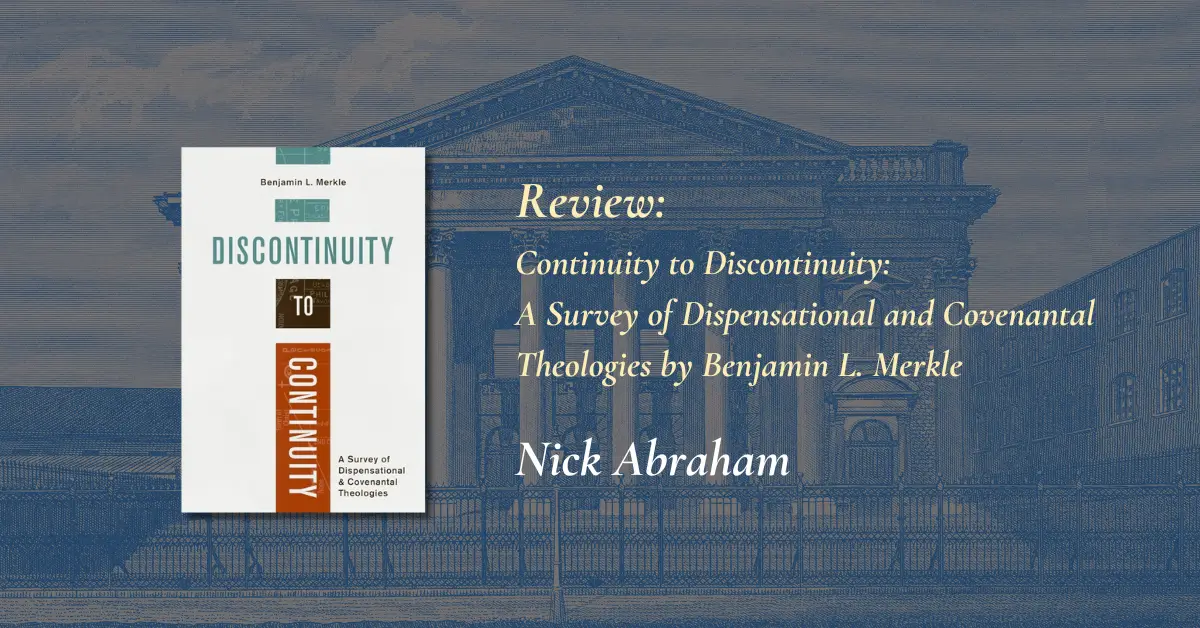
Benjamin L. Merkle serves at Southeastern Baptist Theological Seminary as the M. O. Owens Jr. Chair of New Testament Studies, research professor of New Testament and Greek, and the Associate Dean for Biblical Studies. He is the author of other books such as Going Deeper with New Testament Greek (2016), Exegetical Gems from Biblical Greek(2019), and United to Christ, Walking in the Spirit: A Theology of Ephesians (2022). In his book, Discontinuity to Continuity: A Survey of Dispensational & Covenantal Theologies, he sought to help his readers know what they believe about God’s Word (1–2), to appreciate others’ views (2), to have some humility regarding the imperfections of one’s own theological system (2–3), and to call readers to be students of the Scripture (3–4).
In Discontinuity to Continuity, Merkle compared six different major theological systems in their hermeneutical approaches. He intended to “inform rather than persuade,” and thus he did not provide his own personal choice of theological system (ix). Merkle engaged with the following systems: Classic Dispensationalism, Revised Dispensationalism, Progressive Dispensationalism, Progressive Covenantalism, Covenant Theology, and Christian Reconstructionism. He made his comparisons through the lens of four key questions: 1) what is the basic hermeneutic, 2) what is the relationship between the covenants, 3) what is the relationship between Israel and the church, and 4) what is the kingdom of God? Beneath the first three questions were additional subordinate topics and questions. For question one, he asked whether the hermeneutic was literal or symbolic, he asked about the proper role of typology, and he looked at how the system dealt with Old Testament restoration prophecies for Israel. For question two, he asked whether covenants were conditional or unconditional, how Old Testament saints were saved, and how the law should be applied today. Finally, regarding question three, he asked whether church replaced or fulfilled Israel and he asked how the system interpreted Romans 11:26 and Galatians 6:16. Each system received its own chapter going through each of these key questions and the subordinate topics, and he finished the book with a summary chapter restating the main points of each system.
Merkle rightly rooted the rise of classic dispensationalism in the work of three men: John N. Darby (1800–1882), C. I. Scofield (1843–1921), and Lewis S. Chafer (1871–1952). Classic dispensationalism deployed a literal hermeneutic, yet historical passages thought to relate to the church were to be “spiritualized,” though this was not to be done with prophetic passages (30). Thus, their position on typology was often influenced by such spiritualizing (31–32). Prophecies, however, were always to be fulfilled completely literally (35). The term dispensationalism was derived from the seven dispensations of time thought to be depicted in the Scriptures (36). These dispensations were often sparked, though not always, by one of the biblical covenants (37). Biblical covenants, except for the Mosaic covenant, were thought to be unconditional depicting God’s intention to fulfill His Word. The Mosaic covenant had stipulations to follow and was therefore conditional (37–40).
Classic dispensationalism was noteworthy, Merkle argued, for its perspectives on the Old Testament in relation to the New. This came to the fore in its seeming suggestion that Old Testament saints were saved through law-keeping and New Testament saints were saved through faith in Christ (40–41). Merkle noted that many have rejected this as the stance of classic dispensationalism, yet he displayed the evidence that drives the assumption, particularly from Scofield (40). Second, classic dispensationalism saw no biblical warrant for the Old Testament law to have any bearing on New Testament Christians (41–42). Third, Merkle claimed that the key distinctive of dispensationalism en masse is their belief in the total separation between Israel and the church, such that each are distinct (43–44). Regarding the system’s tendency towards spiritualizing, Merkle stated, “The uneven application of a literal hermeneutic demonstrates that the foundational commitment of dispensationalism is not a literal interpretation of the Bible but a commitment to maintain a firm distinction between Israel and the church” (31). Lastly, because of the Israel/church distinction, classic dispensationalism looked at the kingdom of God as primarily future and literal here on earth, and it separated “the kingdom of heaven” (God’s earthly rule) and “the kingdom of God” (God’s heavenly rule) (45–46).
Next, Merkle considered revised dispensationalism largely through the work of Charles Ryrie (1925–2016), John Walvoord (1910–2002), and J. Dwight Pentecost (1915–2014). This system shares many things with classic dispensationalism with some key updates, which are shown in the New Scofield Study Bible (1967) (53). Revised dispensationalism did not practice the spiritualizing brand of typology of its forefathers. It also was quick to explain that there were not two ways of salvation in the Scriptures, such that it has always been by grace through faith. Finally, the system did not distinguish between “the kingdom of heaven” and “the kingdom of God” as its predecessors (53).
The third and final variety of dispensationalism that Merkle described was progressive dispensationalism. This updated form of dispensational thought was reflected by Merkle in the work of Robert Saucy (1930–2015), Craig Blaising (1949– ), and Darrell Bock (1953– ). Merkle summarized the influences behind this system: “This redefinition reflected an increasing willingness to engage in dialogue with covenantalists, partly in an effort to promote greater harmony but also to refine their dispensational heritage in light of advances in the study of hermeneutics” (78). This system shares a number of things with the other brands of dispensational thought with some key exceptions: a hermeneutic that allows for the original meaning of a text to be expanded through progressive revelation, Israel and the church make up the one people of God, the present age is not viewed as a parenthesis in the plan of God, Jesus has inaugurated the kingdom from heaven, and the whole Bible displays a unified kingdom (79–80).
From this point, Merkle then moved to three systems under the broader head of covenantalism, the first being progressive covenantalism. This view was developed largely by Peter Gentry (1954– ) and Stephen Wellum (1964– ) and is reflected in their book Kingdom Through Covenant. Merkle rightly explained that Gentry and Wellum’s view, by their own admission, is to be separated from what is known as new covenant theology (109). Progressive covenantalism has a hermeneutic that can be described as literal and symbolic, as it seeks to interpret the Scripture according to the author’s intention by considering genre (111). The system’s perspective regarding typology is significant. Wellum summarized, “Typology is a feature of divine revelation rooted in history and the text,” and “Typology is prophetic and predictive and thus divinely intended” (115). Merkle added, “The most common (and most important) types are fulfilled in Jesus” (116).
Progressive covenantalism views Israel and the church as having some continuity and some discontinuity, and like progressive dispensationalism it holds that God has one people (128). Jesus is, Merkle noted, seen as the typological fulfillment of Israel for progressive covenantalism (129). Thus, the system has a progressive perspective when it comes to the biblical covenants—progressive, meaning the plan of God unfolds through the covenants (119). The covenants find their fulfillment in Christ, particularly in the new covenant. This progressive approach with the covenants also describes their view with the kingdom, as is made plain in the title of Gentry and Wellum’s book, Kingdom Through Covenant(133).
Covenant theology is the next system with which Merkle dealt. Key representatives of this view mentioned are Meredith Kline (1922–2007), O. Palmer Robertson (1937– ), and Michael Horton (1964– ). This system is representative of the antithesis of many of the assumptions of the dispensational systems. Covenant theology finds continuity between Israel and the church, which stands out in Merkle’s book as a key issue, if not the key issue, to be used to compare each system. Unique to this system and not found in the other systems thus far mentioned are three theological covenants: the covenant of redemption between the Godhead, the covenant of works (or creation), and the covenant of grace (140). The biblical covenants are either subsumed under these covenants or are informed by them.
Covenant theology utilizes a similar hermeneutic as progressive covenantalism, yet Merkle defined it as being Christocentric (142). The system also embraces sensus plenior, “the idea that earlier revelation can later take on an expanded or fuller meaning,” as does progressive covenantalism (142). Covenant theology has a view of the law in the Scriptures in contrast with the other systems mentioned. It summarizes the law into moral, civil, and ceremonial, whereas the civil and ceremonial laws are fulfilled in Christ, but the moral continues to apply to believers in Jesus (156). Finally, it views the kingdom has come and will come in its fullness at the return of Christ (163–164).
The final system that Merkle discussed was Christian reconstructionism as was taught by Rousas Rushdoony (1916–2001), Greg Bahnsen (1948–1995), and Gary North (1942– ). Merkle summarized the system: “Reconstructionists believe that both church and state are under God’s rule and thus should both be governed by God’s laws. The concepts of the sacred and the secular represent a false dichotomy introduced by unbiblical thought. Instead, society should be reconstructed based on Christian principles found in the Bible” (170). He mentioned five key distinctives of the system that sets it apart from others: Calvinism, theonomy, presuppositional apologetics, postmillennialism, and dominion theology (171–172). These distinctives drive this position’s answers to the main questions that Merkle used throughout the book.
Christian reconstructionists are most comfortable with a symbolic hermeneutic, which is at loggerheads with what they consider to be dispensationalism’s overly literal approach (175). Like covenant theology, the theological covenants are affirmed, though the covenant of works was rejected by Rushdoony (179–180). Their perspective on the law is a key difference from all other systems. They reject natural law, only valuing law that is revealed in Scripture. They reject the threefold division of the law embraced by covenant theologians, noting that all the moral and civil law continues to apply. Jesus’s fulfillment of the law (Matt 5:17–20) is that he fulfilled it for it to be enforced (186). They are comfortable saying that the church replaced Israel, whereas other systems on the covenant theology-side of the spectrum have refuted the label of replacement (188). Finally, the kingdom, according to this system, is already here and thus, all aspects of society must be brought under the kingdom (192).
To evaluate Merkle’s assessment, some critiques of the book will be offered first. Though Merkle stated that he sought to inform regarding these systems rather than convince, he did offer measured critiques in each chapter, which were helpful. However, his overall approach to inform rather than persuade kept him from pushing back a bit more against various aspects of some of the systems. In other words, the book could have been a bit more polemical, and it would not have lost sight of his overall goal. Second, he missed some key theological systems; one of them by his own admission. He noted that he could have talked about the Lutheran approach to the same key questions he asked, which would have been helpful and interesting to have had a chapter on the Lutheran hermeneutic (201–202). Additionally, his chapter on covenant theology was decidedly paedobaptist and could have benefited from including representatives of Baptist covenant theology. Finally, the chapter on Christian reconstructionism either could have been stronger, or the system is just difficult to systematize. That chapter probably should have had some mention of the work of Doug Wilson (1953– ) since his work is adjacent to the movement, though Wilson denies being a reconstructionist.
Merkle offers several helpful things in this book. First, it is accessible; his format structured around the key questions makes the book feel like one of the “Five Views” books. Next, it seems to achieve what he set out to do; a reader will finish this book having a decent grasp on the broad hermeneutical landscape in contemporary evangelicalism. Third, he is gracious; while I did say he probably could have been more polemical, there is no trace of a snarky tone in the book as he described the various theological systems, and this is refreshing. Finally, it is focused on the Scriptures; conversations around these theological systems can often revolve around theological categories to the exclusion of much talk about the Bible—Merkle avoids this.
This book would be a great addition to a biblical studies, biblical theology, or even a systematic theology course, either at the graduate or undergraduate level. As a pastor, I would have no reservations handing this out in the church or using it for a Sunday school class or some other means of discipleship. This is a welcome addition to the broader field of biblical theology.